American Uranium (AMU:AU) has announced Lo Herma Resource Drilling Timing Confirmed
Download the PDF here.
This post appeared first on investingnews.com



American Uranium (AMU:AU) has announced Lo Herma Resource Drilling Timing Confirmed
Download the PDF here.

American Rare Earths Limited (ARR:AU) has announced COB: Repayment of Promissory Note
Download the PDF here.

Jerry Greenfield, co-founder of the Ben & Jerry’s ice cream brand, has stepped down from the company he started 47 years ago citing a retreat from its campaigning spirit under parent company Unilever.
Greenfield wrote in an open letter late Tuesday night — shared on X by his co-founder Ben Cohen — that he could no longer ‘in good conscience’ remain an employee of the company and said the company had been ‘silenced.’
He said the company’s values and campaigning work on ‘peace, justice, and human rights’ allowed it to be ‘more than just an ice cream company’ and said the independence to pursue this was guaranteed when Anglo-Dutch packaged food giant Unilever bought the brand in 2000 for $326 million.
Cohen’s statement didn’t mention Israel’s ongoing military operation in Gaza, but Ben & Jerry’s has been outspoken on the treatment of Palestinians for years and in 2021 withdrew sales from Israeli settlements in what it called ‘Occupied Palestinian Territory.’
Greenfield’s resignation comes five months after Ben & Jerry’s filed a lawsuit accusing Unilever of firing its chief executive, David Stever, over his support for the brand’s political activism. In November last year Ben & Jerry’s filed another lawsuit accusing Unilever of silencing its public statements in support of Palestinian refugees.
‘It’s profoundly disappointing to come to the conclusion that that independence, the very basis of our sale to Unilever, is gone,’ Greenfield said.
‘And it’s happening at a time when our country’s current administration is attacking civil rights, voting rights, the rights of immigrants, women, and the LGBTQ community,’ he added.
Richard Goldstein, the then president of Unilever Foods North America, said in a statement after the sale in 2000 that Unilever was ‘in an ideal position to bring the Ben & Jerry’s brand, values and socially responsible message to consumers worldwide.’
But now Greenfield claims Ben & Jerry’s ‘has been silenced, sidelined for fear of upsetting those in power.’ He said he would carry on campaigning on social justice issues outside the company.
The financial performance of the Ben & Jerry’s brand isn’t made public but Unilever’s ice cream division made 8.3 billion Euros ($9.8 billion) in revenue in 2024. Unilever is in the process of spinning off its ice cream division, however, into a separate entity which involves cutting some 7,500 jobs across its brands globally.
Cohen and Greenfield founded the business in 1978 in Burlington, Vermont, where it is still based.
NBC News has contacted Unilever for comment overnight but had not received any at the time of publication.
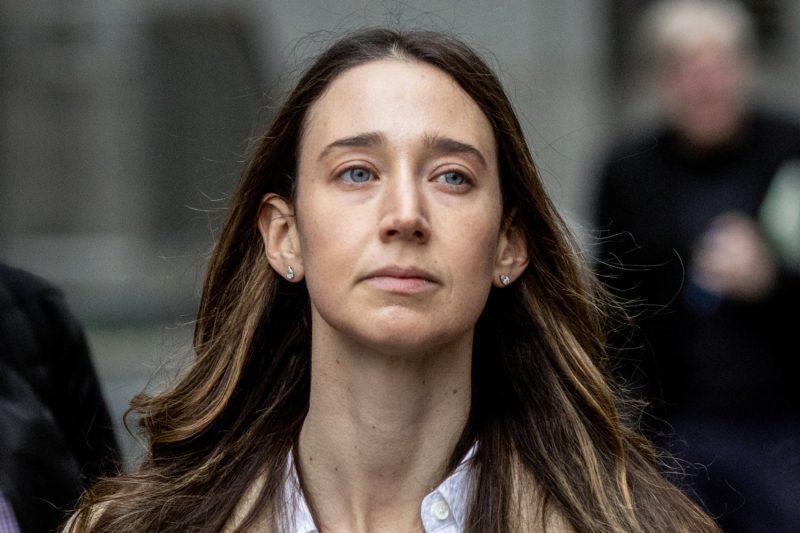
Charlie Javice, the founder of a startup company that sought to dramatically improve how students apply for financial aid, was sentenced Monday to more than seven years in prison for cheating JPMorgan Chase out of $175 million by greatly exaggerating how many students it served.
Javice, 33, was sentenced in Manhattan federal court for her March conviction by Judge Alvin K. Hellerstein, who said she committed “a large fraud” by duping the bank giant in the summer of 2021. She made false records that made it seem the company, called Frank, had over 4 million customers when it had fewer than 300,000, Hellerstein found.
The judge said Javice had assembled a “very powerful list” of her charitable acts, which included organizing soup kitchens for the homeless when she was 7 years old and designing career programs for formerly incarcerated women.
In court papers, defense lawyers noted that Javice has faced extraordinary public scrutiny, reputational destruction and professional exile, “making her a household name” in the same way Elizabeth Holmes became synonymous with her blood-testing company, Theranos.
Defense attorney Ronald Sullivan told Hellerstein that his client was very different from Holmes because what she created actually worked, unlike Holmes, “who did not have a real company” and whose product “in fact endangered patients.”
In seeking a 12-year prison sentence for Javice, prosecutors cited a 2022 text Javice sent to a colleague in which she called it “ridiculous” that Holmes got over 11 years in prison.
Hellerstein largely dismissed arguments that he should be lenient because the acquisition pitted “a 28-year-old versus 300 investment bankers from the largest bank in the world,” as Sullivan put it.
Still, the judge criticized the bank, saying “they have a lot to blame themselves” after failing to do adequate due diligence. He quickly added, though, that he was “punishing her conduct and not JPMorgan’s stupidity.”
Sullivan said the bank rushed its negotiations because it feared another bank would acquire Frank first.
A prosecutor, Micah Fergenson, though, said JPMorgan “didn’t get a functioning business” in exchange for its investment. “They acquired a crime scene.”
Fergenson said Javice was driven by greed when she saw that she could pocket $29 million from the sale of her company.
“Ms. Javice had it dangling in front of her and she lied to get it,” he said.
Given a chance to speak, Javice said she was “haunted that my failure has transformed something meaningful into something infamous.” She said she “made a choice that I will spend my entire life regretting.”
Javice, sometimes speaking through tears, apologized and sought forgiveness from “all the people touched or tarnished by my actions,” including JPMorgan shareholders, Frank employees and investors, along with her family.
Javice, who lives in Florida, has been free on $2 million bail since her 2023 arrest.
At trial, Javice, a graduate of the University of Pennsylvania’s Wharton School of Business, was convicted of conspiracy, bank fraud and wire fraud charges. Her lawyers had argued that JPMorgan went after Javice because it had buyer’s remorse.
In her mid-20s, Javice founded Frank, a company with software that promised to simplify the arduous process of filling out the Free Application for Federal Student Aid, a complex government form used by students to apply for aid for college or graduate school.
Frank’s backers included venture capitalist Michael Eisenberg. The company said its offering, akin to online tax preparation software, could help students maximize financial aid while making the application process less painful.
The company promoted itself as a way for financially needy students to obtain more aid faster, in return for a few hundred dollars in fees. Javice appeared regularly on cable news programs to boost Frank’s profile, once appearing on Forbes’ “30 Under 30” list before JPMorgan bought the startup in 2021.
Javice was among a number of young tech executives who vaulted to fame with supposedly disruptive or transformative companies, only to see them collapse amid questions about whether they had engaged in puffery and fraud while dealing with investors.
In their pre-sentence submission, prosecutors wrote that they were requesting a lengthy prison sentence to send a message that fraud in the sale of startup companies is “no less blameworthy than other types of fraud and will be punished accordingly.”
Prosecutors added that the message was “desperately needed” because of “an alarming trend of founders and executives of small startup companies engaging in fraud, including making misrepresentations about their companies’ core products or services, in order to make their companies attractive targets for investors and/or buyers.”

YouTube said Monday it would settle a lawsuit brought by President Donald Trump for more than $24 million, adding to a growing list of settlements with tech and media companies that have amassed millions of dollars for Trump’s projects.
Trump sued after his YouTube account was banned in 2021. After the Jan. 6 riot, YouTube said content posted to Trump’s channel raised “concerns about the ongoing potential for violence.” His account was reinstated in 2023.
Monday’s settlement makes YouTube the last major tech platform to settle a lawsuit with Trump, who similarly sued Meta and Twitter for banning his accounts in the aftermath of Jan. 6. Meta, the owner of Facebook and Instagram, settled for $25 million, while Twitter, since renamed X, settled for about $10 million.
A notice of settlement for Trump’s lawsuit against YouTube details that $22 million of it will go toward building a new White House ballroom. Trump has touted that the addition will have room for 900 people, and the White House has said it could cost $200 million to build.
Other plaintiffs that joined Trump’s suit, such as the American Conservative Union and a number of other people, will get $2.5 million of the settlement.
In addition to tech companies, many major media outlets have settled lawsuits with Trump over the past year.
In July, Paramount Global settled with him for $16 million after he took issue with a “60 Minutes” interview with Kamala Harris that aired on CBS.
In December, Disney settled with Trump over a lawsuit in which he accused ABC and anchor George Stephanopoulos of defamation in an interview with Rep. Nancy Mace, R-S.C. Disney paid Trump’s future presidential library $15 million as part of the settlement.
Disney came under pressure from the administration again when it recently suspended “Jimmy Kimmel Live!” for nearly a week after two major station owners threatened to stop airing the show. One of the station owners, Nexstar, is seeking clearance from Trump’s Federal Communications Commission chairman for a $6.2 billion merger.
The other station owner, Sinclair, is reportedly considering a merger, which the FCC would also need to approve.
Trump is also suing The Wall Street Journal over its reporting about his friendship with Jeffrey Epstein, and he recently sued The New York Times for $15 billion. A judge struck down that lawsuit, though Trump could refile it.

The S&P 500 ($SPX) just logged its fifth straight trading box breakout, which means that, of the five trading ranges the index has experienced since the April lows, all have been resolved to the upside.
How much longer can this last? That’s been the biggest question since the massive April 9 rally. Instead of assuming the market is due to roll over, it’s been more productive to track price action and watch for potential changes along the way. So far, drawdowns have been minimal, and breakouts keep occurring. Nothing in the price action hints at a lasting change — yet.
While some are calling this rally “historic,” we have a recent precedent. Recall that from late 2023 through early 2024, the index had a strong start and gave way to a consistent, steady trend.
From late October 2023 through March 2024, the S&P 500 logged seven consecutive trading box breakouts. That streak finally paused with a pullback from late March to early April, which, as we now know, was only a temporary hiccup. Once the bid returned, the S&P 500 went right back to carving new boxes and climbing higher.
If there’s been one gripe about this rally, it’s that the number of new highs within the index has lagged. As we’ve discussed before, among all the internal breadth indicators available, new highs almost always lag — that’s normal. What we really want to see is whether the number of new highs begins to exceed prior peaks as the market continues to rise, which it has, as shown by the blue line in the chart below.
As of Wednesday’s close, 100 S&P 500 stocks were either at new 52-week highs or within 3% of them. That’s a strong base. We expect this number to continue rising as the market climbs, especially if positive earnings reactions persist across sectors.
Even when we get that first day with 100+ S&P 500 stocks making new 52-week highs, though, it might not be the best time to initiate new longs.
The above chart shows that much needs to align for that many stocks to peak in unison, which has historically led to at least a short-term consolidation, if not deeper pullbacks — as highlighted in yellow. Every time is different, of course, but this is something to keep an eye on in the coming weeks.
The GoNoGo Trend remains in bullish mode, with the recent countertrend signals having yet to trigger a greater pullback.
We still have two live bullish upside targets of 6,555 and 6,745, which could be with us for a while going forward. For the S&P 500 to get there, it will need to form new, smaller versions of the trading boxes.
In the chart below, you can view a rising wedge pattern on the recent price action, the third since April. The prior two wedges broke down briefly and did not lead to a major downturn. The largest pullbacks in each case occurred after the S&P 500 dipped below the lower trendline of the pattern.
The deepest drawdown so far is 3.5%, which is not exactly a game-changer. Without downside follow-through, a classic bearish pattern simply can’t be formed, let alone be broken down from.
We’ll continue to monitor these formations as they develop because, at some point, that will change.

In this video, Mary Ellen spotlights the areas driving market momentum following Taiwan Semiconductor’s record-breaking earnings report. She analyzes continued strength in semiconductors, utilities, industrials, and AI-driven sectors, plus highlights new leadership in robotics and innovation-focused ETFs like ARK. From there, Mary Ellen breaks down weakness in health care and housing stocks, shows how to refine trade entries using hourly charts, and compares today’s rally to past market surges. Watch as she explores setups in silver and examines individual stocks like Nvidia, BlackRock, and State Street.
This video originally premiered on July 18, 2025. You can watch it on our dedicated page for Mary Ellen’s videos.
New videos from Mary Ellen premiere weekly on Fridays. You can view all previously recorded episodes at this link.
If you’re looking for stocks to invest in, be sure to check out the MEM Edge Report! This report gives you detailed information on the top sectors, industries and stocks so you can make informed investment decisions.
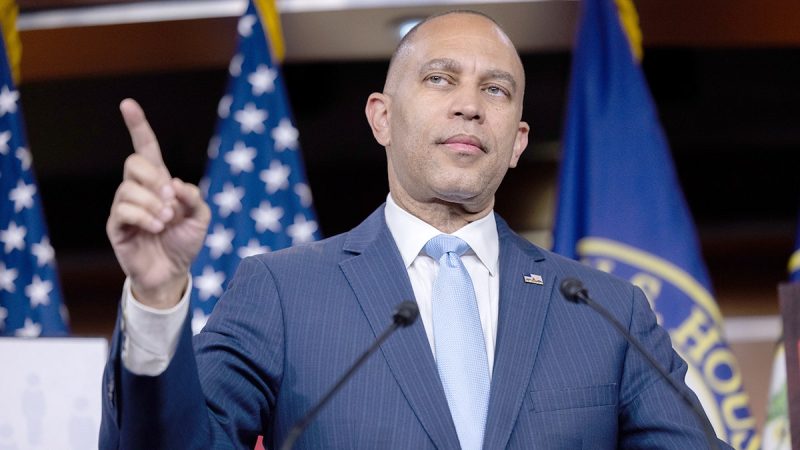
House Democrats made a last-ditch effort to pass their own government funding proposal on Tuesday, which was quickly scuttled by the GOP.
Democrats are pushing a short-term extension of the current federal funding levels — called a continuing resolution (CR) — through Oct. 31, which also includes a host of left-wing policy riders derided by Republicans as non-starters.
With the deadline to avert a government shutdown less than 12 hours away, Democrat lawmakers gathered on the House floor with the intent of calling for unanimous consent to pass their bill.
It takes just one House Republican to block such a move, which appears to be what Rep. Warren Davidson, R-Ohio, was poised to do. Dozens of Democrats, meanwhile, were gathered on the House floor to await the move.
But the Republican designated to run the floor for the day, Rep. Morgan Griffith, R-Va., ignored their yells of ‘Mr. Speaker.’ He instead gaveled out the House’s brief session without acknowledging them at all.
Sparse chants of ‘shame on you’ could be heard from Democrats after the session ended.
Under rules dictated by the Constitution, the chamber must meet for brief periods every few days called ‘pro forma’ sessions to ensure continuity, even if there are no formal legislative matters at hand.
Pro forma sessions can also be opportunities for lawmakers to give brief speeches or introduce legislation that they otherwise would not have.
The House passed a GOP-led CR largely along party lines earlier this month. It would keep current government funding levels roughly flat until Nov. 21 to give Congress more time to strike a deal on fiscal year 2026 spending levels.
The measure is free from other policy riders, save for about $88 million toward enhanced security for lawmakers, the White House and the judicial branch — which has bipartisan support.
But Democrats, furious at being sidelined in those government funding discussions, are calling for both an extension of COVID-19 pandemic-era Obamacare subsidies and an end to Republicans’ recent Medicaid cuts in exchange for their support.
Their CR proposal would have reversed those Medicaid changes and restored federal funding to NPR and PBS that Republicans cut earlier this year.
Republicans, including President Donald Trump, have accused Democrats of making unreasonable partisan demands while holding federal government operations hostage in the process.
The House-passed CR is expected to be considered in the Senate later on Tuesday, where at least some Democrat support is needed to meet the 60-vote threshold to overcome a filibuster.
The government will likely enter into a partial shutdown at midnight if that legislation fails.
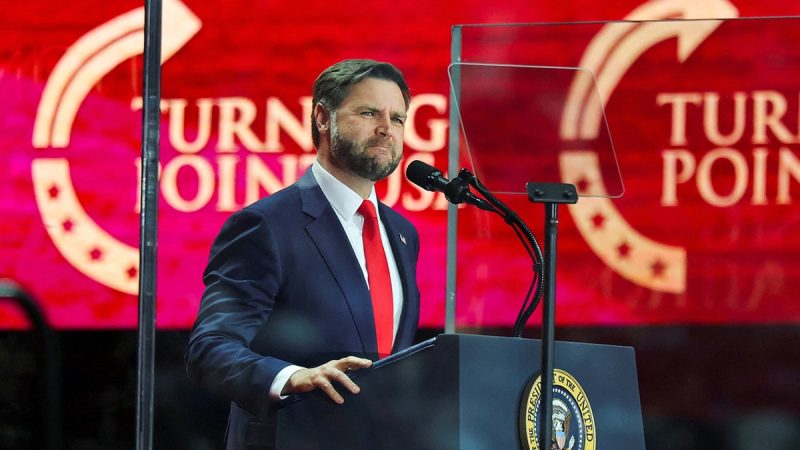
Vice President JD Vance and Donald Trump Jr. will attend events in the coming months for Turning Point USA, the influential conservative youth organization co-founded by their close friend, the late Charlie Kirk.
The news, first reported by Axios, was confirmed to Fox News Digital on Tuesday morning by a source close to both the vice president and Trump Jr., the eldest son of President Donald Trump.
Kirk, the co-founder of the politically potent conservative youth organization, close ally and outside advisor to the president and vice president and media star, was shot and killed earlier this month while speaking at a college campus event at Utah Valley University.
The source close to both Vance and Trump Jr. said they ‘were so personally close to Charlie that they are determined to do right by him and continue to work closely with Turning Point.’
Vance accompanied Kirk’s widow Erika on Air Force two to transport Charlie Kirk’s body from Utah back to their hometown of Phoenix, Arizona.
A few days later, the vice president guest-hosted Kirk’s highly popular podcast.
Both Vance and Trump Jr., as well as the president, also spoke at Kirk’s memorial service in Arizona.
‘I would expec to see both of them turn up at TPUSA events over the next several months and long after that,’ the source said of Vance and Trump Jr. ‘They understand that Turning Point is now Charlie’s political legacy, and they both want to help grow it to be bigger and more influential than ever.’
Turning Point USA’s political arm was successful in driving up the youth vote for Trump and Republicans in last year’s election, when the GOP won back the White House and control of the Senate and held onto its House majority.
And Trump’s political team wants to make sure Turning Point USA, now under the leadership of Erika Kirk, remains well funded and politically potent ahead of next year’s midterm elections.
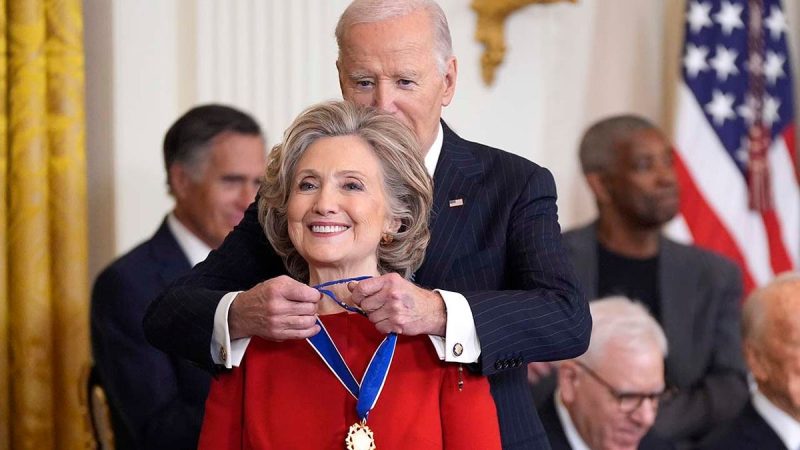
Unearthed note cards from the Biden era show the administration detailed the names and photos of high-profile Democrats, such as former Secretary of State Hillary Clinton, as well as lesser-known individuals for then-President Joe Biden to ostensibly reference during live events, documents obtained by Fox News Digital show.
Five different ‘palm cards,’ which are hand-sized note cards frequently used by politicians for quick reminders or talking points during public events, especially while on the campaign trail, were uncovered amid an investigation of National Archive documents related to the Biden administration’s use of an autopen, and obtained by Fox News Digital.
Four of the five cards obtained by Fox Digital are stamped with a disclaimer reading, ‘PRESIDENT HAS SEEN,’ while a fifth card detailing an ABC News reporter’s question to Biden during a press conference did not include that stamp.
It is unclear if Biden relied on each of the cards during the various public events. Fox News Digital reached out to Biden’s office for any comment and clarification on the use of the cards but did not immediately receive a reply.
Clinton was among a handful of Americans who received a Presidential Medal of Freedom, the highest civilian honor in the U.S., in the waning days of the Biden administration. One of the palm cards obtained by Fox Digital reads ‘Presidential Medal of Freedom Recipients’ and was followed by photos and short biographies of the recipients, including a photo of Clinton and a short note detailing she ‘was the Secretary of State in the Obama-Biden administration.’
The note card also included a photo of Hollywood actor Denzel Washington, who also received the prestigious award in January, and a note describing him as an actor, director and producer whom the New York Times called ‘one of the greatest actors of the 21st century.’ The note also had photos and short bios for lesser known individuals who received the award, including renowned chef José Andrés and businessman and philanthropist David Rubenstein.
Another palm card simply reading, ‘Judicial Confirmations Milestone Speech,’ showed a photo of Schumer and a separate photo of Senate Majority Whip Dick Durbin accompanied by the roles in the Senate, their party and the states they represent. The card included a stamp reading, ‘PRESIDENT HAS SEEN.’
Biden celebrated his administration confirming 235 judicial nominees in January in a speech from the State Dining Room and was joined by Schumer and Durbin during the event. Durbin and Schumer also held other public events celebrating the Biden administration’s judicial confirmation strides earlier in Biden’s Oval Office tenure.
Another palm card listed out various family members of Hollywood legend Francis Ford Coppola ahead of the 47th Kennedy Center Honors in December 2024 that honored ‘The Godfather’ director.
A fourth palm card was timestamped ‘Saturday, January 18 Greets,’ and showed a photo and short bio of White House Historical Association President Stewart McLaurin, as well as another section reading, ‘Pritzker Family,’ which displayed a photo of Democratic Illinois Gov. JB Pritzker, and photos and explainers on Pritzker’s wife, son and daughter, Fox News Digital found. A photo of the palm card also read ‘PRESIDENT HAS SEEN.’
It is unclear if Pritzker visited the White House Jan. 18, which fell on a Saturday.
The fifth card detailed a question from ABC News’ reporter Mary Bruce. A handwritten note on the card states ‘Question #3.’
‘2024: How do YOU view the path forward? How do YOU think about YOUR place in history?’ the card reads.
‘Speaker McCarthy/Debt Limit: Depending on what happens with the House vote on the Speaker’s debt limit bill tomorrow, do do YOU anticipate moving forwards?’
A Fox News Digital review found that the ABC News journalist asked Biden about his re-election effort during a joint press conference with the South Korean president April 26, 2023, in the Rose Garden. Bruce was the third reporter to ask Biden a question during the press conference, which fell on the same day House Republicans approved a bill to increase the debt ceiling.
‘My turn to ask a question? I think the next question is Mary Bruce, ABC,’ Biden said during the press conference.
Bruce asked, ‘You recently launched your reelection campaign. You’ve said questions about your age are ‘legitimate.’ And your response is always, ‘Just watch me.’ But the country is watching, and recent polling shows that 70 percent of Americans, including a majority of Democrats, believe you shouldn’t run again. What do you say to them? What do you say to those Americans who are watching and aren’t convinced?’
‘You’ve said you can beat Trump again. Do you think you’re the only one?’ she added.
Biden’s use of palm cards has long been documented, including during the April 2023 press conference with Bruce. Fox News Digital previously reported that Biden flashed a separate card showing the photo, name and name pronunciation of Los Angeles Times journalist Courtney Subramanian, while noting the card was part of ‘Question #1.’
Subramanian asked the first question during the press conference, with Biden calling on ‘Courtney of the Los Angeles Times.’
Biden flashed another palm card showing photos of reporters, accompanied by their outlets and roles, during a joint press conference with the Australian prime minister in October 2023. At his first formal press conference as president in March 2021, Biden was seen handling a card that had statistics and talking points to use.
In another image, Biden was consulting a list of preselected reporters along with their photos, Fox Digital previously reported.
Politicians long have used palm cards while on the campaign trail. Biden’s use of the cards while serving as president added fuel to the fire of concern over his mental acuity, though, including Axios reporting in 2024 that donors were spooked by Biden’s reliance on the notes.
The White House pointed to President Donald Trump’s public events where he routinely takes questions from journalists off the cuff when asked about Trump’s potential use of palm cards.
‘President Trump gives unfettered access to the media and answers every question imaginable, without pre-screening the press questions or collecting reporters’ palm cards ahead of time like his incompetent predecessor,’ White House spokeswoman Taylor Rogers told Fox Digital Tuesday when approached for comment. ‘Unlike Joe Biden, President Trump is actually running our country, and he doesn’t ever shy away from taking on the fake news to deliver the truth.’
A senior White House press official added to Fox News that the press office ‘does not prepare any reporter palm cards’ and that the team does not ‘ask for reporters to submit their questions to the president ahead of time.’
The Biden administration is currently facing scrutiny over the use of an autopen to sign official documents — including for clemency orders, executive orders and other official documents. The use of the autopen follows years of mounting concern that Biden’s mental acuity and health were deteriorating, which hit a fever pitch during the 2024 campaign cycle following the president’s disastrous debate performance against Trump.
Biden ultimately dropped out of the presidential race as the concerns mounted.
Since reclaiming the Oval Office, Trump has balked at his predecessor’s use of the autopen, claiming Biden’s staff allegedly used the pen to sign off on presidential actions unbeknownst to Biden. Trump ordered an investigation into the use of the autopen under the Biden administration back in June.
Fox News Digital’s Lindasy Kornick contributed to this report.