Rapid Critical Metals (RCM:AU) has announced Execution of SPA to Acquire Webbs Consol from Lode Resources
Download the PDF here.
This post appeared first on investingnews.com



Rapid Critical Metals (RCM:AU) has announced Execution of SPA to Acquire Webbs Consol from Lode Resources
Download the PDF here.

(TheNewswire)
Announces Expanded Drill Plan
Vancouver, British Columbia TheNewswire – September 29th, 2025 Prismo Metals Inc. (the ‘ Company ‘) (CSE: PRIZ,OTC:PMOMF) (OTCQB: PMOMF) is pleased to report that it has received final assay results including overlimits for the first batch of twenty-three samples taken at the Silver King project located in Arizona. The new assays include 619 gt Ag and 511 gt Ag for two samples taken at the Silver King shaft area, as well as 757 gt Ag, 1.5% Cu, 6.7% Pb, and 11.5% Zn for the recently encountered polymetallic vein. Preliminary assay data was described in a news release dated September 24, 2025.
‘The overlimit assays for silver highlight the high-grade nature of both the mineralization around the Silver King mine and the recently encountered polymetallic vein. The results confirm the significance of the recently discovered polymetallic vein as a new exploration target at the Silver King project,’ said Dr. Craig Gibson, Chief Exploration Officer. ‘Overlimit copper assays ranging from 1.11% to 2.43% copper for three samples from the replacement mineralization area provides encouraging data for this style of mineralization. The replacement mineralization occurs along strike with the stratigraphic horizon at the nearby Magma mine and occurs as a large body on the Black Diamond claim.’
Figure 1 . Geologic and land map of the Silver King project showing newly described polymetallic vein in magenta (Ag-Pb-Zn), copper vein in green (Cu-Ag) and stratigraphically controlled replacement mineralization in red. The strongly altered intrusion with stockwork quartz-pyrite veining is indicated by the crosshatch.
Table 1. Assay results for samples with overlimits from the Silver King project
|
Sample |
Au g/t |
Ag g/t |
Cu % |
Pb % |
Zn % |
Sb ppm |
Bi ppm |
Ba ppm |
Hg ppm |
|
New polymetallic vein |
|||||||||
|
544510 |
0.03 |
757 |
1.51 |
6.69 |
11.53 |
7788 |
0.3 |
>10000 |
12.84 |
|
Silver King mine |
|||||||||
|
544514 |
1.07 |
619 |
0.59 |
0.44 |
0.63 |
337 |
3 |
>10000 |
1.7 |
|
544517 |
0.04 |
511 |
0.09 |
0.26 |
0.43 |
377 |
0.2 |
>10000 |
15.66 |
|
Cu replacement zone |
|||||||||
|
544502 |
0.47 |
7 |
1.35 |
– |
0.02 |
0.8 |
71.8 |
30 |
|
|
544507 |
2.26 |
25 |
2.43 |
– |
0.23 |
0.4 |
33.5 |
12 |
0.01 |
|
544508 |
0.73 |
12 |
1.11 |
– |
0.28 |
0.4 |
29.1 |
12 |
0.03 |
|
544552 |
|
35 |
0.14 |
2.81 |
2.21 |
114 |
0.5 |
24 |
2.11 |
.
Figure 2 . Map showing Silver King project and nearby mineral deposits. The Silver King deposit is located 3km from the Resolution Copper deposit ( a joint venture between Rio Tinto and BHP ) and the high-grade Magma mine, a former copper and silver producer.
Drill Program Update
Prior to the discovery of the mineralized veins and porphyry related style mineralization announced recently, Prismo had planned a drill program at the historic Silver King mine for about 1,000 meters. That drill plan was designed to test the upper half of the steeply dipping pipelike Silver King mineralized body as well as potential mineralization adjacent to the dense stockwork that was the focus of historic mining.
Following the recent discoveries, Prismo is planning to add second phase of drilling for an additional 1,000 meters. This additional program will focus on the newly identified targets outside of the historic mining area, such as the polymetallic vein and the copper vein mentioned above. Drilling of a large body of replacement mineralization on the patented Black Diamond claim is also being planned and is road accessible on private ground.
Figure 3 . Cross section through the Silver King mine workings showing proposed drill holes (in black) to test the pipelike mineralized body (in red)
Click Image To View Full Size
Figure 4. Planned drill pads for the Silver King project.
‘Much of the focus of the exploration program to date has consisted of a property-wide survey of historic mines and prospects surrounding the direct Silver King workings,’ said Gordon Aldcorn, President of Prismo. ‘ This work has expanded our geological thinking and resulted in the recognition of several new types of mineralization at the project, providing additional targets for exploration. Prismo has already submitted a plan of operations for the drill program with Forest Services. Some of the drilling sites considered for the new targets will be subject to further permitting applications.’
Figure 5. Copper assays for samples taken at the Silver King project.
Figure 6. Silver assays for samples taken at the Silver King project.
Table 4. Locations for samples mentioned in the text.
|
Sample |
Location |
Type/width (m) |
E WGS84 |
N WGS84 |
|
544502 |
Black Diamond |
Grab |
492,633 |
3,687,623 |
|
544507 |
Replacement zone |
Dump |
492,054 |
3,687,431 |
|
544508 |
Replacement zone |
0.7 |
491,986 |
3,687,334 |
|
544510 |
Polymetallic vein |
Dump |
491,863 |
3,687,565 |
|
544514 |
Silver King Mine |
Dump |
491,855 |
3,687,907 |
|
544517 |
Silver King Mine |
Dump |
491,855 |
3,687,907 |
|
544552 |
Replacement zone float |
Selected |
491,928 |
3,688,043 |
Sample data previously released in News Release dated September 24, 2025.
QA/QC
Samples were analyzed by SGS, an internationally recognized analytical lab, with preparation at the Tempe, Arizona facility and analyses at the Burnaby laboratory. Prismo inserts control samples consisting of standard pulps and coarse blanks in the sample stream for QA/QC purposes and also utilizes the labs internal control samples.
Qualified Person
Dr. Craig Gibson, PhD., CPG., a Qualified Person as defined by NI-43-101 regulations and Chief Exploration Officer and a director of the Company, has reviewed and approved the technical disclosures in this news release. The historic data presented in this press release was obtained from public sources, should be considered incomplete and is not qualified under NI 43-101, but is believed to be accurate. The Company has not verified the historical data presented and it cannot be relied upon, and it is being used solely to aid in exploration plans. References to mineralization at the Magma Mine and Resolution Copper deposit are not necessarily indicative to the mineralization on the Silver King property.
About the Silver King
Discovered in 1875, the Silver King mine was one of Arizona ‘ s most important historic producers, yielding nearly 6 million ounces of silver at grades of up to 61 oz/t. The Silver King mine sits only 3 km from the main shaft of the Resolution Copper project — a joint venture between Rio Tinto and BHP and one of the world ‘ s largest unmined copper deposits with an estimated copper resource of 1.787 billion metric tonnes at an average grade of 1.5% copper (1) . The unique land position is fully surrounded by Resolution Copper ‘ s claim block, offering strategic upside. Selected samples from small-scale production in the late 1990s returned grades as high as 644 oz/t silver (18,250 g/t) and 0.53 oz/t gold (15 g/t), indicating that high-grade mineralization remains.
(2) Briggs, D., 2015, Superior, Arizona: An old mining camp with many lives, Ariz. Geol Survey Contributed Report CR-15-D, 13p.
About Prismo Metals Inc.
Prismo (CSE: PRIZ,OTC:PMOMF) is a mining exploration company focused on advancing its Silver King, Ripsey and Hot Breccia projects in Arizona and its Palos Verdes silver project in Mexico.
Please follow @PrismoMetals on , , , Instagram , and
Prismo Metals Inc.
1100 – 1111 Melville St., Vancouver, British Columbia V6E 3V6
Phone: (416) 361-0737
Contact:
Alain Lambert, Chief Executive Officer alain.lambert@prismometals.com
Gordon Aldcorn, President gordon.aldcorn@prismometals.com
Cautionary Note Regarding Forward-Looking Information
This release includes certain statements and information that may constitute forward-looking information within the meaning of applicable Canadian securities laws. Forward-looking statements relate to future events or future performance and reflect the expectations or beliefs of management of the Company regarding future events. Generally, forward-looking statements and information can be identified by the use of forward-looking terminology such as ‘ intends’ or ‘ anticipates’, or variations of such words and phrases or statements that certain actions, events or results ‘ may’, ‘ could’, ‘ should’, ‘ would’ or ‘ occur’. This information and these statements, referred to herein as ‘forward‐looking statements’, are not historical facts, are made as of the date of this news release and include without limitation, statements regarding discussions of future plans, estimates and forecasts and statements as to management’s expectations and intentions with respect to, among other things: the timing, costs and results of drilling at Silver King.
These forward‐looking statements involve numerous risks and uncertainties, and actual results might differ materially from results suggested in any forward-looking statements. These risks and uncertainties include, among other things: delays in obtaining or failure to obtain appropriate funding to finance the exploration program at Silver King.
In making the forward-looking statements in this news release, the Company has applied several material assumptions, including without limitation, that: the ability to raise capital to fund the drilling campaign at Silver King and the timing of such drilling campaign.
Although management of the Company has attempted to identify important factors that could cause actual results to differ materially from those contained in forward-looking statements or forward-looking information, there may be other factors that cause results not to be as anticipated, estimated or intended. There can be no assurance that such statements will prove to be accurate, as actual results and future events could differ materially from those anticipated in such statements. Accordingly, readers should not place undue reliance on forward-looking statements and forward-looking information. Readers are cautioned that reliance on such information may not be appropriate for other purposes. The Company does not undertake to update any forward-looking statement, forward-looking information or financial outlook that are incorporated by reference herein, except in accordance with applicable securities laws. We seek safe harbor.
Copyright (c) 2025 TheNewswire – All rights reserved.
News Provided by TheNewsWire via QuoteMedia

Locksley Resources (LKY:AU) has announced Completion of Tranche 2 Placement Issue
Download the PDF here.

Jerry Greenfield, co-founder of the Ben & Jerry’s ice cream brand, has stepped down from the company he started 47 years ago citing a retreat from its campaigning spirit under parent company Unilever.
Greenfield wrote in an open letter late Tuesday night — shared on X by his co-founder Ben Cohen — that he could no longer ‘in good conscience’ remain an employee of the company and said the company had been ‘silenced.’
He said the company’s values and campaigning work on ‘peace, justice, and human rights’ allowed it to be ‘more than just an ice cream company’ and said the independence to pursue this was guaranteed when Anglo-Dutch packaged food giant Unilever bought the brand in 2000 for $326 million.
Cohen’s statement didn’t mention Israel’s ongoing military operation in Gaza, but Ben & Jerry’s has been outspoken on the treatment of Palestinians for years and in 2021 withdrew sales from Israeli settlements in what it called ‘Occupied Palestinian Territory.’
Greenfield’s resignation comes five months after Ben & Jerry’s filed a lawsuit accusing Unilever of firing its chief executive, David Stever, over his support for the brand’s political activism. In November last year Ben & Jerry’s filed another lawsuit accusing Unilever of silencing its public statements in support of Palestinian refugees.
‘It’s profoundly disappointing to come to the conclusion that that independence, the very basis of our sale to Unilever, is gone,’ Greenfield said.
‘And it’s happening at a time when our country’s current administration is attacking civil rights, voting rights, the rights of immigrants, women, and the LGBTQ community,’ he added.
Richard Goldstein, the then president of Unilever Foods North America, said in a statement after the sale in 2000 that Unilever was ‘in an ideal position to bring the Ben & Jerry’s brand, values and socially responsible message to consumers worldwide.’
But now Greenfield claims Ben & Jerry’s ‘has been silenced, sidelined for fear of upsetting those in power.’ He said he would carry on campaigning on social justice issues outside the company.
The financial performance of the Ben & Jerry’s brand isn’t made public but Unilever’s ice cream division made 8.3 billion Euros ($9.8 billion) in revenue in 2024. Unilever is in the process of spinning off its ice cream division, however, into a separate entity which involves cutting some 7,500 jobs across its brands globally.
Cohen and Greenfield founded the business in 1978 in Burlington, Vermont, where it is still based.
NBC News has contacted Unilever for comment overnight but had not received any at the time of publication.

In this video, Mary Ellen spotlights the areas driving market momentum following Taiwan Semiconductor’s record-breaking earnings report. She analyzes continued strength in semiconductors, utilities, industrials, and AI-driven sectors, plus highlights new leadership in robotics and innovation-focused ETFs like ARK. From there, Mary Ellen breaks down weakness in health care and housing stocks, shows how to refine trade entries using hourly charts, and compares today’s rally to past market surges. Watch as she explores setups in silver and examines individual stocks like Nvidia, BlackRock, and State Street.
This video originally premiered on July 18, 2025. You can watch it on our dedicated page for Mary Ellen’s videos.
New videos from Mary Ellen premiere weekly on Fridays. You can view all previously recorded episodes at this link.
If you’re looking for stocks to invest in, be sure to check out the MEM Edge Report! This report gives you detailed information on the top sectors, industries and stocks so you can make informed investment decisions.

The S&P 500 ($SPX) just logged its fifth straight trading box breakout, which means that, of the five trading ranges the index has experienced since the April lows, all have been resolved to the upside.
How much longer can this last? That’s been the biggest question since the massive April 9 rally. Instead of assuming the market is due to roll over, it’s been more productive to track price action and watch for potential changes along the way. So far, drawdowns have been minimal, and breakouts keep occurring. Nothing in the price action hints at a lasting change — yet.
While some are calling this rally “historic,” we have a recent precedent. Recall that from late 2023 through early 2024, the index had a strong start and gave way to a consistent, steady trend.
From late October 2023 through March 2024, the S&P 500 logged seven consecutive trading box breakouts. That streak finally paused with a pullback from late March to early April, which, as we now know, was only a temporary hiccup. Once the bid returned, the S&P 500 went right back to carving new boxes and climbing higher.
If there’s been one gripe about this rally, it’s that the number of new highs within the index has lagged. As we’ve discussed before, among all the internal breadth indicators available, new highs almost always lag — that’s normal. What we really want to see is whether the number of new highs begins to exceed prior peaks as the market continues to rise, which it has, as shown by the blue line in the chart below.
As of Wednesday’s close, 100 S&P 500 stocks were either at new 52-week highs or within 3% of them. That’s a strong base. We expect this number to continue rising as the market climbs, especially if positive earnings reactions persist across sectors.
Even when we get that first day with 100+ S&P 500 stocks making new 52-week highs, though, it might not be the best time to initiate new longs.
The above chart shows that much needs to align for that many stocks to peak in unison, which has historically led to at least a short-term consolidation, if not deeper pullbacks — as highlighted in yellow. Every time is different, of course, but this is something to keep an eye on in the coming weeks.
The GoNoGo Trend remains in bullish mode, with the recent countertrend signals having yet to trigger a greater pullback.
We still have two live bullish upside targets of 6,555 and 6,745, which could be with us for a while going forward. For the S&P 500 to get there, it will need to form new, smaller versions of the trading boxes.
In the chart below, you can view a rising wedge pattern on the recent price action, the third since April. The prior two wedges broke down briefly and did not lead to a major downturn. The largest pullbacks in each case occurred after the S&P 500 dipped below the lower trendline of the pattern.
The deepest drawdown so far is 3.5%, which is not exactly a game-changer. Without downside follow-through, a classic bearish pattern simply can’t be formed, let alone be broken down from.
We’ll continue to monitor these formations as they develop because, at some point, that will change.
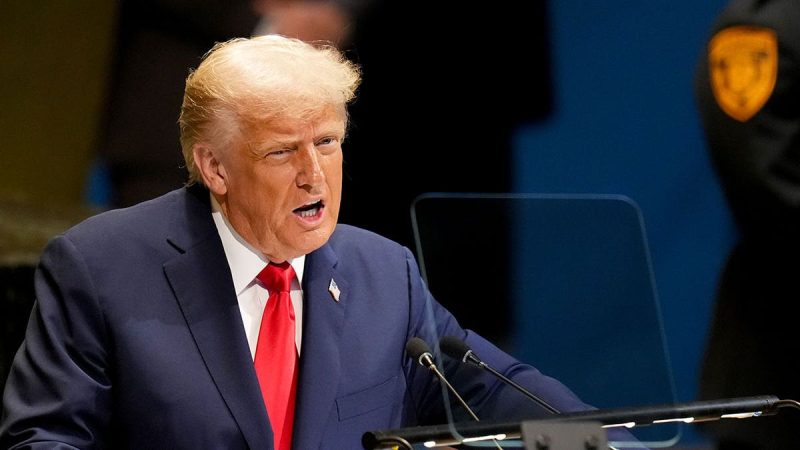
President Donald Trump kicked off the week delivering remarks at the United Nations General Assembly, and closed it out by attending the 2025 Ryder Cup golf competition.
During his address to the U.N. General Assembly debate Tuesday, Trump cautioned that Europe is in a crisis due to an influx of illegal immigration and warned that U.N. countries are ‘going to hell’ in the ‘failed experiment of open borders.’
‘Europe is in serious trouble,’ Trump said Tuesday. ‘They’ve been invaded by a force of illegal aliens like nobody’s ever seen before. Illegal aliens are pouring into Europe. Nobody is ever. And nobody’s doing anything to change it, to get them out. It’s not sustainable. And because they choose to be politically correct, they’re doing just absolutely nothing about it.’
The Trump administration has taken a tough stance against illegal immigrants to advance Trump’s mass deportation agenda.
‘The U.N. is supposed to stop invasions, not create them and not finance them,’ Trump said. ‘In the United States, we reject the idea that mass numbers of people from foreign lands can be permitted to travel halfway around the world, trample our borders, violate our sovereignty, cause unmitigated crime, and deplete our social safety net. We have reasserted that America belongs to the American people, and I encourage all countries to take their own stand in defense of their citizens as well.’
After his remarks before the General Assembly and after meeting with Ukrainian President Volodymyr Zelenskyy, Trump said that he believes Ukraine, with the backing of the European Union, could secure back all of its territory as the war between Russia and Ukraine persists.
‘After getting to know and fully understand the Ukraine/Russia Military and Economic situation and, after seeing the Economic trouble it is causing Russia, I think Ukraine, with the support of the European Union, is in a position to fight and WIN all of Ukraine back in its original form,’ Trump said in a Tuesday Truth Social post. ‘With time, patience, and the financial support of Europe and, in particular, NATO, the original Borders from where this War started, is very much an option.’
‘Why not? Russia has been fighting aimlessly for three and a half years a War that should have taken a Real Military Power less than a week to win,’ Trump said. ‘This is not distinguishing Russia. In fact, it is very much making them look like ‘a paper tiger.’’
Meanwhile, Trump headed to Farmingdale, New York, Friday along with his granddaughter Kai for the Ryder Cup golf competition at Bethpage Black Course.
Trump has appeared at two other sporting events in New York in September: the U.S. Open men’s final and a New York Yankees game Sept. 11.
Fox News’ Paulina Dedaj and Ryan Morik contributed to this report.

Jerry Greenfield, co-founder of the Ben & Jerry’s ice cream brand, has stepped down from the company he started 47 years ago citing a retreat from its campaigning spirit under parent company Unilever.
Greenfield wrote in an open letter late Tuesday night — shared on X by his co-founder Ben Cohen — that he could no longer ‘in good conscience’ remain an employee of the company and said the company had been ‘silenced.’
He said the company’s values and campaigning work on ‘peace, justice, and human rights’ allowed it to be ‘more than just an ice cream company’ and said the independence to pursue this was guaranteed when Anglo-Dutch packaged food giant Unilever bought the brand in 2000 for $326 million.
Cohen’s statement didn’t mention Israel’s ongoing military operation in Gaza, but Ben & Jerry’s has been outspoken on the treatment of Palestinians for years and in 2021 withdrew sales from Israeli settlements in what it called ‘Occupied Palestinian Territory.’
Greenfield’s resignation comes five months after Ben & Jerry’s filed a lawsuit accusing Unilever of firing its chief executive, David Stever, over his support for the brand’s political activism. In November last year Ben & Jerry’s filed another lawsuit accusing Unilever of silencing its public statements in support of Palestinian refugees.
‘It’s profoundly disappointing to come to the conclusion that that independence, the very basis of our sale to Unilever, is gone,’ Greenfield said.
‘And it’s happening at a time when our country’s current administration is attacking civil rights, voting rights, the rights of immigrants, women, and the LGBTQ community,’ he added.
Richard Goldstein, the then president of Unilever Foods North America, said in a statement after the sale in 2000 that Unilever was ‘in an ideal position to bring the Ben & Jerry’s brand, values and socially responsible message to consumers worldwide.’
But now Greenfield claims Ben & Jerry’s ‘has been silenced, sidelined for fear of upsetting those in power.’ He said he would carry on campaigning on social justice issues outside the company.
The financial performance of the Ben & Jerry’s brand isn’t made public but Unilever’s ice cream division made 8.3 billion Euros ($9.8 billion) in revenue in 2024. Unilever is in the process of spinning off its ice cream division, however, into a separate entity which involves cutting some 7,500 jobs across its brands globally.
Cohen and Greenfield founded the business in 1978 in Burlington, Vermont, where it is still based.
NBC News has contacted Unilever for comment overnight but had not received any at the time of publication.
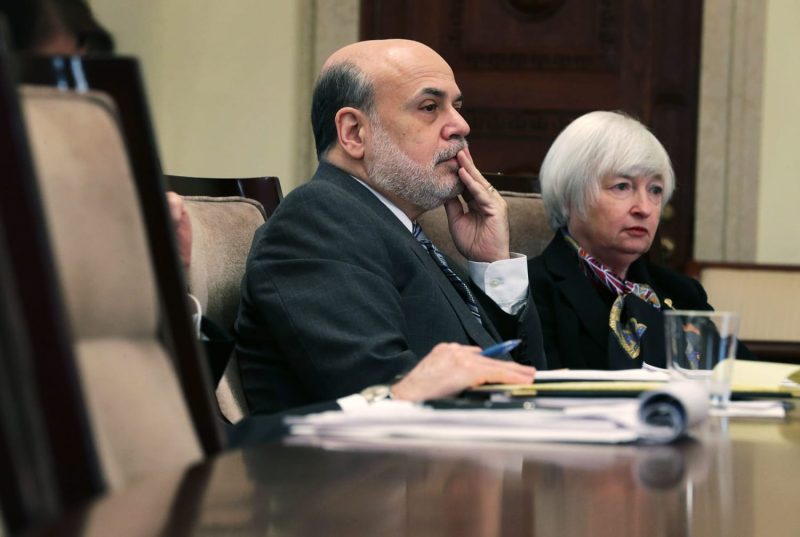
A group of the country’s top economic leaders, including every living former Federal Reserve chair, filed an amicus brief with the Supreme Court on Thursday in support of Fed governor Lisa Cook, who President Donald Trump is seeking to remove.
The group, led former central bank chiefs Alan Greenspan, Ben Bernanke and Janet Yellen, said that “allowing the removal of Governor Lisa D. Cook while the challenge to her removal is pending would threaten that independence and erode public confidence in the Fed.”
The bipartisan group, which also includes former Treasury Secretaries Robert Rubin, Larry Summers, Hank Paulson, Jack Lew and Timothy Geithner, added that “the independence of the Federal Reserve, within the limited authority granted by Congress to achieve the goals Congress itself has set, is a critical feature of our national monetary system.”
As the U.S. central bank, the Federal Reserve is part of the U.S. government and its leaders are put in place by elected officials, but it also retains a considerable amount of independence that is meant to allow it to make decisions purely out of economic concerns rather than political ones.
The former economic officials said that an erosion of Fed independence could result “in substantial long-term harm and inferior economic performance overall.”
The Supreme Court is considering whether Trump has the authority to fire Cook, who has been a target for the White House for weeks as part of a broader pressure campaign to push the Fed to more aggressively cut interest rates.
Cook’s attempted removal stems from allegations of mortgage fraud, made in August by top Trump ally and Federal Housing Finance Authority Director Bill Pulte.
Cook has repeatedly denied the allegations and has not been charged with any crime. Documents reviewed by NBC News in mid-September appeared to contradict Pulte’s allegations.
Two courts have so far blocked Cook’s removal, leading Trump to ask the Supreme Court a week ago to allow him to fire her. In a court filing, Solicitor General D. John Sauer said a judge’s ruling that blocked the firing constituted “improper judicial interference.”
In a filing to the Supreme Court on Thursday, Cook’s lawyers said that ‘she committed neither ‘fraud’ nor ‘gross negligence’ in relation to her mortgages.’
Cook asked the court to deny Trump’s attempt to remove her while the case is argued.
The White House has repeatedly maintained that Trump “lawfully removed Lisa Cook for cause.”
The brief filed Thursday is a who’s who of the country’s top economic minds. Former Fed governor Dan Tarullo is also listed as a signatory to the brief, as well as the economists Ken Rogoff, Phil Gramm and John Cochrane.
Glenn Hubbard, Greg Mankiw, Christina Romer, Cecilia Rouse, Jared Bernstein and Jason Furman, a group who served as top officials on the White House’s council of economic advisers during Republican and Democrat administrations, also signed the brief.
None of the officials who signed the filing have served in either of Trump’s administrations.
Trump is the first president in U.S. history to try to remove a sitting Fed official.
‘There is broad consensus among economists, based on decades of macroeconomic research, that a more independent central bank will lead to lower and more stable inflation without creating higher unemployment — thus helping to achieve the Federal Reserve’s statutory objective of price stability and maximum employment,’ the officials said in the brief.
‘The Federal Reserve walks a careful line in pursuit of its goals.’
They noted that ‘elected officials often favor lowering interest rates to boost employment, particularly leading up to an election.’
‘Although that approach may satisfy voters temporarily, it does not lead to lasting gains for unemployment or growth and can instead lead to persistently higher inflation in the long-term and thus ultimately harm the national economy.’
The former Fed chairs and economic officials, in their filing, highlight a notorious case of political pressure on the Fed:
‘In the early 1970s, President Richard Nixon famously exerted political pressure over then-Chair of the Fed Arthur Burns to lower unemployment by reducing interest rates. During this period ‘the Fed made only limited efforts to maintain policy independence and, for doctrinal as well as political reasons, enabled a decade of high and volatile inflation.’ This contributed to an ‘inflationary boom’ and deep recession that took years to bring back under control.’

The S&P 500 ($SPX) just logged its fifth straight trading box breakout, which means that, of the five trading ranges the index has experienced since the April lows, all have been resolved to the upside.
How much longer can this last? That’s been the biggest question since the massive April 9 rally. Instead of assuming the market is due to roll over, it’s been more productive to track price action and watch for potential changes along the way. So far, drawdowns have been minimal, and breakouts keep occurring. Nothing in the price action hints at a lasting change — yet.
While some are calling this rally “historic,” we have a recent precedent. Recall that from late 2023 through early 2024, the index had a strong start and gave way to a consistent, steady trend.
From late October 2023 through March 2024, the S&P 500 logged seven consecutive trading box breakouts. That streak finally paused with a pullback from late March to early April, which, as we now know, was only a temporary hiccup. Once the bid returned, the S&P 500 went right back to carving new boxes and climbing higher.
If there’s been one gripe about this rally, it’s that the number of new highs within the index has lagged. As we’ve discussed before, among all the internal breadth indicators available, new highs almost always lag — that’s normal. What we really want to see is whether the number of new highs begins to exceed prior peaks as the market continues to rise, which it has, as shown by the blue line in the chart below.
As of Wednesday’s close, 100 S&P 500 stocks were either at new 52-week highs or within 3% of them. That’s a strong base. We expect this number to continue rising as the market climbs, especially if positive earnings reactions persist across sectors.
Even when we get that first day with 100+ S&P 500 stocks making new 52-week highs, though, it might not be the best time to initiate new longs.
The above chart shows that much needs to align for that many stocks to peak in unison, which has historically led to at least a short-term consolidation, if not deeper pullbacks — as highlighted in yellow. Every time is different, of course, but this is something to keep an eye on in the coming weeks.
The GoNoGo Trend remains in bullish mode, with the recent countertrend signals having yet to trigger a greater pullback.
We still have two live bullish upside targets of 6,555 and 6,745, which could be with us for a while going forward. For the S&P 500 to get there, it will need to form new, smaller versions of the trading boxes.
In the chart below, you can view a rising wedge pattern on the recent price action, the third since April. The prior two wedges broke down briefly and did not lead to a major downturn. The largest pullbacks in each case occurred after the S&P 500 dipped below the lower trendline of the pattern.
The deepest drawdown so far is 3.5%, which is not exactly a game-changer. Without downside follow-through, a classic bearish pattern simply can’t be formed, let alone be broken down from.
We’ll continue to monitor these formations as they develop because, at some point, that will change.