International Graphite (IG6:AU) has announced Feedback of U.S. Department of Defense Award Funding
Download the PDF here.
This post appeared first on investingnews.com



International Graphite (IG6:AU) has announced Feedback of U.S. Department of Defense Award Funding
Download the PDF here.

White Cliff Minerals Limited (“WCN” or the “Company”) (ASX: WCN; OTCQB: WCMLF) is pleased to announce it has received firm commitments to raise approximately A$14.4m (before costs) through the issue of 384,615,398 new, fully paid ordinary shares in the Company. Utilising the “flow-through shares” provisions under Canadian tax law 307,692,321 shares will be issued at an issue price of A$0.0403 per share representing a 38.9% premium to WCN’s last trading price of A$0.029 (14 May 2025) for a total of A$12.40m (Flow-Through). Additionally, the Company has received firm commitments to raise $2 million (before costs) through a share placement to new and existing sophisticated and professional investors (Placement). 76,923,077 shares will be issued under the Placement at $0.026 per share, being a 10.3% discount to the Company’s last closing price before trading halt.
”The successful completion of this capital raise is a testament to the quality of our Rae Copper Project and the confidence that investors have in our exploration strategy. The ability to access the less dilutive flow through funds at a circa 40% premium is a huge advantage and value accretive for shareholders. Further, John Hancock and his Astrotricha Capital Family Office cornerstone position in the raise, along with the support of other high net worth investors introduced by Astrotricha, reflects their shared vison for the future of WCN and underpins the Company’s development plans for the Rae Copper Project.
The outlook for copper prices remains robust and the Company is poised to ramp up exploration efforts as we capitalise on its strong financial position following this raise, in addition to the ongoing conversion of WCNO options. Following recent high-grade results, this upcoming drilling at Danvers will lay the foundation for a maiden exploration target at the project over the coming period. We are very excited about the potential to delineate a material resource around the immediate drilling area at Danvers and to potentially encompass additional deposits along the regional 7km + strike.
In parallel, drilling will commence at the major sedimentary hosted copper target at Hulk. The pre collars that we have completed at Hulk sit only about 50mtrs above the target horizon and with diamond rigs planned to arrive in the coming months at which time we plan to drill all project areas and deliver on the potential for an additional major copper discovery at our Rae Project.”
Troy Whittaker – Managing Director
“Starting out as a Strategic Advisor to WCN with an initial invested stake, I have now become the Company’s largest shareholder and am pleased to see another well executed and strongly supported capital raise at a premium to the share price. The WCN focus has been on minimising existing shareholder dilution whilst attracting strategic investor capital to accelerate exploration and at the same time, securing the Company’s financial position for the longer term. There is now global investor interest in WCN’s prospects and I look forward to further upcoming drill results.”
John Hancock – Strategic Advisor to WCN
Click here for the full ASX Release

Uvre Limited (ASX: UVA) (the Company or Uvre) is pleased to announce that highly regarded mining entrepreneurs Norman Seckold and Peter Nightingale will be appointed non-executive directors of Uvre with effect from settlement of the acquisition by the Company of 100% of the issued share capital of MEL (Acquisition). Norman Seckold and Peter Nightingale will emerge with 16.5% and 1.3% respective stakes in the Company upon settlement of the Acquisition and Equity Raise.
Highlights
Uvre Executive Chairman Brett Mitchell said:
“This transaction is an exceptional opportunity for Uvre on several levels.
“Norm and Peter will bring a wealth of knowledge and experience in the resources business, along with a track record of creating substantial shareholder value through resource asset exploration and proįect development.
“The Otagold proįects led by Waitekauri have compelling gold exploration upside in a tier-one įurisdiction, as shown by the extensive mineralisation and drilling targets already identified.
“The combination of Norman’s well-known record in building successful mining proįects combined with the talented Uvre team, the immense exploration upside at these proįects and the strong financial position which will follow the placement will leave Uvre very well-placed to create significant value”.
Norman Seckold said:
“This transaction will enable Uvre to unlock what we believe is the substantial value of these proįects.
“We will have the assets, the team, the experience and the financial strength to conduct the immediate exploration programs which will maximise our ability to create value.
“The work we have already done on the proįects shows they are highly prospective and with the support of the Uvre team and access to capital, we can take them to the next level with the aim of building substantial gold inventories in a tier one location”.
Otagold Projects Summary
Otagold holds a 100% interest in three exploration permits, one prospecting permit and one prospecting permit application on New Zealand’s North and South Islands, covering 332km2 of highly prospective ground.
Click here for the full ASX Release

Astute Metals NL (ASX: ASE) (“ASE”, “Astute” or “the Company”) is pleased to report assay results from the first of six holes completed as part of its highly successful April 2025 diamond drilling campaign at the 100%-owned Red Mountain Lithium Project in Nevada, USA. Drill-hole RMDD003 has returned three high- grade intersections of lithium mineralisation:
Key Highlights
To hear CEO Matt Healy discuss this ASX Release click here
The thick zones of lithium mineralisation encountered in the northernmost drill-hole at Red Mountain highlight the increasing scale of the project, with strong lithium mineralisation now intersected in all drill- holes spanning a north-south strike extent of over 5.6km and surface sample geochemistry indicating further potential to the north, south and west of the current drilled extents7, 9 (Figure 3).
Of particular significance in hole RMDD003 is the high-grade nature of the mineralisation. The nearest drill-hole is RMDD002, which intersected 32.1m @ 2,050ppm within a broader 86.9m intersection at 1,470ppm Li from 18.3m. The high-grade zone in RMDD002 has persisted north to RMDD003, and increased in grade significantly to over 3,000ppm lithium.
Assays are pending for the other five holes drilled as part of the April diamond drilling campaign.
Astute Chairman, Tony Leibowitz, said:
“Our 2025 exploration campaign is off to a fantastic start, with exceptional assays returned for the first step-out diamond hole, RMDD003. We are impressed by the thickness and grade of the mineralisation, with the high-grade intercept returned from this hole showing that the previously identified high-grade zone extends for a considerable distance to the north.
“This provides further indication that Red Mountain is unfolding as a lithium discovery of significance in North America. With mineralisation now defined by drilling over a strike length of almost 6 kilometres, we are looking forward to seeing what the remaining drill-holes will deliver. The information obtained from this round of drilling should put us on a clear trajectory to advance Red Mountain towards a maiden JORC Mineral Resource Estimate later this year.”
Background
Located in central-eastern Nevada (Figure 4) adjacent to the Grand Army of the Republic Highway (Route 6), which links the regional mining towns of Ely and Tonopah, the Red Mountain Project was staked by Astute in August 2023.
The Project area has broad mapped tertiary lacustrine (lake) sedimentary rocks known locally as the Horse Camp Formation2. Elsewhere in the state of Nevada, equivalent rocks host large lithium deposits (see Figure 4) such as Lithium Americas’ (NYSE: LAC) 62.1Mt LCE Thacker Pass Project3, American Battery Technology Corporation’s (OTCMKTS: ABML) 15.8Mt LCE Tonopah Flats deposit4 and American Lithium (TSX.V: LI) 9.79Mt LCE TLC Lithium Project5.
Astute has completed substantial surface sampling campaigns at Red Mountain, which indicate widespread lithium anomalism in soils and confirmed lithium mineralisation in bedrock with some exceptional grades of up to 4,150ppm Li2,8 (Figure 3).
A total of 13 RC and diamond drill holes have been drilled at the project for a combined 1,944m, prior to this current drilling program. These campaigns were highly successful, intersecting strong lithium mineralisation in every hole9.
Scoping leachability testwork on mineralised material from Red Mountain indicates high leachability of lithium of up to 98%, varying with temperature, acid strength and leaching duration, and proof of concept beneficiation test-work has indicated the potential to upgrade the Red Mountain mineralisation10,11.
Results
Hole RMDD003 successfully intersected three zones of lithium mineralised clay-bearing mudstones and sandstone, separated by narrow zones of unmineralised rocks (Figure 1). The intersections are as follows:
The best grades were developed in the most clay-rich zones (Figure 2). An internal very high-grade zone of 8.6m returned a grade of 5,060ppm Li, with a maximum single sample grade of 5,660ppm Li from 69.2-70.7m (227-232ft), which is the drill sample with the highest lithium grade achieved to date at the project.
Click here for the full ASX Release

The S&P 500 ($SPX) just staged one of the sharpest rebounds we’ve seen in years. After tumbling into deeply oversold territory earlier this year, the index has completely flipped the script—short-term, medium-term, and even long-term indicators are now pointing in a new direction.
One longer-term indicator that hit an extreme low in early April was the 14-week relative strength index (RSI), which dropped to 27. That’s among the lowest levels since the 2008 financial crisis.
The obvious takeaway: it was a great time to buy, even in cases where the low RSI didn’t mark the low. Everyone who pounded the table a few weeks ago has been proven right, even if the rebound was faster and stronger than most could’ve predicted. So, what happens next?
The long-term picture looks promising, but markets rarely move in a straight line. Even though the market was higher months and years after these deeply oversold readings, the path wasn’t a straight shot to new highs (even if long-term log charts sometimes make it look that way).
The chart below shows the lowest weekly RSI readings in the S&P 500 since 2008.
FIGURE 1. THE LOWEST WEEKLY RSI READING SIN THE S&P 500 SINCE 2008.
Almost every time, there was a pause, often more than one. Some were sharp, others more prolonged. The first real test typically came when RSI bounced back to the 50-zone (the mid-point of its range). Each of these moments is highlighted in yellow in the chart below.
FIGURE 2. AFTER DEEPLY OVERSOLD RSI READINGS, THERE WAS OFTEN A PAUSE IN THE INDEX.
As shown, this often marked the initial digestion phase after the face-ripping rally off the lows. Eventually, the SPX climbed back to a weekly overbought condition, but not right away. This pattern was clearest in 2011, 2015–16, and 2022. The depressed weekly RSI showed that things were getting washed out, but volatility persisted before a lasting uptrend took hold.
Indeed, the current snapback is one of the quickest and most powerful turnarounds in decades, but this pace is also unsustainable. A slowdown is inevitable.
So how does the market handle the next round of profit-taking? By continuing to make higher lows – and converting those into additional bullish patterns.
The market comeback has been led by large-cap growth; that much is clear. The Technology Select Sector SPDR ETF (XLK) has roared back nearly 30% in just six weeks. That’s a massive move in a short period, and far larger than any failed bear market rally seen in 2022. The best six-week rally back then came in the summer and topped out at 17%.
The last time we saw a six-week gain of 20%+ was the period following the COVID-19 low in spring 2020. As we know, that snapback continued, with XLK overtaking its pre-crash highs and ultimately rallying 160% into the early 2022 peak.
This isn’t a prediction, but we shouldn’t ignore it either. Why? Because before 2020, the last such move happened in April 2009, right after the ultimate low of the 2008 financial crisis.
FIGURE 3. WEEKLY CHART OF XLK.
The Industrial Select Sector SPDR ETF (XLI) and XLK are the first sector ETFs to register overbought 14-day RSI readings. While that suggests a short-term pause could be near, it wouldn’t be a negative. As the weekly chart shows, a pullback could help complete a large bullish formation.
Once again, bouts of intense volatility eventually can lead to the biggest bullish chart formations. Let’s keep XLI on our radar screens.
FIGURE 4. WEEKLY CHART OF XLI.
The Invesco Solar ETF (TAN), which has been stuck in a brutal downtrend for years, just rocketed higher by 40%, using intra-day highs and lows. That rally has produced the first overbought reading since late May 2024, which, notably, lasted only a day before momentum faded.
Yesterday, TAN tagged its 200-day moving average, prompting a round of profit-taking. This sets up a critical test for TAN, which has consistently failed at resistance or after short-term pops. Selling strength in TAN has been a highly effective strategy for quite some time.
FIGURE 5: DAILY CHART OF TAN.
The weekly chart clearly shows this pattern playing out since TAN topped in early 2021. Like anything else, TAN could eventually turn the corner—but to do so, it would need to form a legitimate higher low from here.
For now, the downtrend deserves respect. Chasing this move is not advised. Selling strength remains the recommended approach—until proven otherwise.
FIGURE 6. WEEKLY CHART OF TAN.
Yes, the market’s comeback has been fast and fierce. But fast moves don’t necessarily mean a straight path higher. Expect slowdowns and pullbacks, watch for bullish setups, and don’t chase runaway rallies. There’s opportunity out there, but it’s all about timing and discipline.

Looking for breakout stocks and top market leaders? Follow along Mary Ellen shares stock breakouts, analyst upgrades, and sector leadership trends to help you trade strong stocks in today’s market.
In this week’s episode, Mary Ellen reveals the stocks leading the market higher and explains what’s fueling their strength. She highlights base breakouts, analyst upgrades, and leadership stocks gaining momentum. In addition, she screens for emerging breakout candidates you should have on your radar.
This video originally premiered May 16, 2025. You can watch it on our dedicated page for Mary Ellen’s videos.
New videos from Mary Ellen premiere weekly on Fridays. You can view all previously recorded episodes at this link.
If you’re looking for stocks to invest in, be sure to check out the MEM Edge Report! This report gives you detailed information on the top sectors, industries and stocks so you can make informed investment decisions.
We’ve all heard the classic market maxim, “Sell in May and go away.” For many investors, that’s the introduction to market seasonality that suggests a six month period where it’s just best to avoid stocks altogether.
Through my own experience, complemented with interviews with seasonality experts like ” We’ll dig deeper into the history of “Sell in May,” analyze summer trends in recent years, and focus on signs to follow in the weeks and months ahead! Sign up HERE for this free event!
It turns out that the reason why “sell in May” has often worked out is less about May being super weak, but more about how major lows have usually come in the fall months. Since the COVID low in early 2020, we’ve experienced major lows in September or October every year except for 2024.
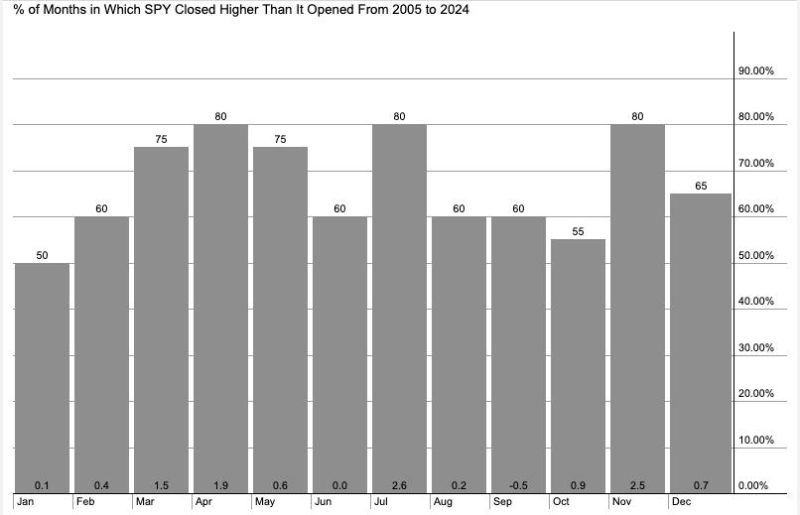
When we focus on the last five years, we can see that the May-June-July period has been consistently strong. In fact, May and July have seen bullish trends every year since 2019. So while investors often talk about the “summer doldrums” and weakness into the hot summer months, the recent evidence would suggest otherwise.
The weakest months since the COVID low have actually been January, February, September, and October. So again, it’s been less about weakness in the spring, and much more about weaker price action into the traditional low in September or October. Also note the strength in November, where the market is almost always rallying off a major low and setting up for a positive finish to the calendar year!
As I mentioned earlier, I like to think of seasonal patterns as tendencies. There is no guarantee that July will be strong, and there is no way I can tell you for sure that the market will make yet another major low in September. Seasonality tells you the general bias to the markets, but mindful investors know the most important evidence is price itself.
Given the extreme rally off the early April low, we’ve seen a rapid rotation from bearish sentiment to more bullish outlooks as investors have started to believe in the new uptrend phase. This week’s price gap higher for the S&P 500 could provide a perfect support range to monitor in the coming weeks and months.
If the S&P 500 is able to hold 5750, and remain above the support range set from the gap earlier this month, then perhaps the equity markets will follow the same pattern as recent years and remain strong into August.
If, however, the S&P 500 is unable to hold this key support range, and we also confirm that breakdown with weaker momentum readings and deteriorating breadth conditions, then the S&P 500 may be charting a new course through what has become a strong period in the calendar year.
RR#6,
Dave
PS- Ready to upgrade your investment process? Check out my free behavioral investing course!
David Keller, CMT
President and Chief Strategist
Sierra Alpha Research LLC
https://www.youtube.com/c/MarketMisbehavior
Disclaimer: This blog is for educational purposes only and should not be construed as financial advice. The ideas and strategies should never be used without first assessing your own personal and financial situation, or without consulting a financial professional.
The author does not have a position in mentioned securities at the time of publication. Any opinions expressed herein are solely those of the author and do not in any way represent the views or opinions of any other person or entity.

The top tax-writer in the House of Representatives is arguing that President Donald Trump’s ‘big, beautiful bill’ will be ‘big’ for American taxpayers as well – including seniors.
House Ways & Means Committee Chairman Jason Smith, R-Mo., and other Republicans on the panel spent months negotiating behind closed doors on how to enact Trump’s tax policies.
Among those is an added $4,000 deduction for Americans aged 65 or older. Seniors with income of less than $75,000 as single filers, and less than $150,000 as joint filers, would be eligible for the full deduction, which then would begin to phase out.
‘So, that’s on top of their guaranteed deduction, and that’s per person . . . anyone who has total earnings of $75,000 a year or less is going to be made completely whole, so all the low-income and middle-income seniors on Social Security will be paying zero on Social Security in the long run,’ Smith told Fox News Digital, while adding of others, ‘most of them will be paying much less.’
Republicans are using the budget reconciliation process, which lowers the Senate’s threshold for passage from 60 votes to 51 for certain pieces of fiscal legislation, to advance a vast bill full of Trump’s priorities on taxes, immigration, energy, defense and the national debt.
Because the House already operates under a simple majority, reconciliation allows the party in power to pass sweeping legislation while sidelining the other side, in this case, Democrats.
Trump has directed congressional Republicans to permanently extend his 2017 Tax Cuts and Jobs Act (TCJA), as well as implement new policies eliminating taxes on tips, overtime pay and retirees’ Social Security.
But the law that established the reconciliation process, the Congressional Budget Act of 1974, also specifically forbade direct changes to Social Security via the process.
Smith said Republicans’ had added $4,000 tax deduction as a way to make them ‘completely whole.’
Rather than seeing that tax relief month-to-month, however, Smith said it would come in people’s yearly tax returns.
He argued that it was more beneficial for lower-income seniors as well, giving added relief to those whose incomes were too low to pay Social Security taxes in the first place.
‘Under the rules of reconciliation, you cannot touch Social Security directly. What we did is to make sure that they get . . . tax relief for any senior who makes less than $75,000 per year,’ Smith said. ‘It’s not that we didn’t want to do it, it’s that it cannot be done under the rules of reconciliation, or you wouldn’t qualify for the 51-vote threshold over in the United States Senate.’
‘But the tax relief they will receive is an added tax cut, and that will make up for what they have paid in Social Security tax.’
The White House also endorsed Smith’s plan despite its departure from Trump’s initial campaign pitch.
‘The One, Big, Beautiful Bill not only delivers permanent tax cuts and bigger paychecks, but it secures a historic tax break for seniors on Social Security,’ White House spokesperson Anna Kelly said. ‘This is another promise made, promise kept to our seniors who deserve much-needed tax relief after four years of suffering under Bidenflation.’
The $4,000 tax deduction, which would be in effect from the 2025 through 2028 tax years, would be on top of the higher standard deduction that people above age 65 already receive.
It would not be a tax credit, reducing tax liability directly regardless of tax brackets. A deduction reduces taxable income and is dependent on the taxpayer’s rate.
But for single seniors making up to $75,000, and married seniors making less than $150,000, qualifying for the $4,000 deduction, it would likely provide some relief for millions of taxpayers across the country.
‘It’ll be a wash of what their Social Security tax would’ve been,’ Smith said, adding later in the interview: ‘Failure’s not an option. We’re going to get this done.’
President Donald Trump’s bold executive order on drug pricing isn’t just policy—it’s a revolution in healthcare affordability. The plan is simple yet transformative: ensure Americans pay no more for medications than citizens of other wealthy nations.
Consider this stark reality: a GLP-1 drug costing $88 in London commands $1,000 in the United States. Even after manufacturer discounts to insurers, Americans still pay over $400—for the identical medication, from the same company, produced in the same facility. This disparity is especially galling when pharmaceutical companies extract 70% of their profits from America—a nation representing just 4% of the world’s population. This global free-riding on American patients ends now.
Industry leaders recognize this imbalance. I’ve already engaged with CEOs from four major American pharmaceutical companies and a foreign manufacturer eager to relocate to the U.S. Their response has been encouraging, but we’re prepared to act decisively if necessary. U.S. Health and Human Services and Centers for Medicare & Medicaid Services (CMS) possess the statutory authority to deliver on President Trump’s commitment: other developed nations must pay more, so Americans can pay less, thus preserving the innovation pipeline.
Americans deserve both groundbreaking therapies and affordable access to them. Yet according to the Kaiser Family Foundation, nearly one-third of patients skip prescribed medications due to cost—an unacceptable reality in the world’s wealthiest nation.
While prevention through healthier lifestyles remains our best strategy for reducing medication dependence, certain treatments will always be essential. The pharmaceutical industry has delivered remarkable advancements in cancer and autoimmune therapies that benefit patients worldwide.
We value continued innovation as a core American principle, but we cannot indefinitely subsidize global medical progress while other wealthy nations contribute disproportionately little.
President Trump’s negotiation approach has already proven effective with NATO, where European countries responded to accountability by making historic reinvestments that strengthened the alliance. The same principle applies here. The President and I stand united: global free riding on American patients must end.
CMS, with Dr. Mehmet Oz at the helm, extends beyond payment reform to fundamentally realigning care delivery incentives. This initiative will protect safety nets for vulnerable populations while addressing the financial pressures facing state partners and federal programs—particularly Medicaid, which has seen dramatic growth in both enrollment and costs.
The coming months will be decisive in achieving President Trump’s prescription for a healthier America—one where innovation thrives, and patients no longer shoulder an unfair share of the global healthcare burden.

‘For posterity’s sake.’
Those words from President Joe Biden sum up the crushing impact of the leaked audiotapes from the interview between him and Special Counsel Robert Hur. Not only did they remove any doubt over Biden committing federal crimes, but they also constituted what is akin to a political racketeering indictment against much of the Washington establishment, from the White House staff to Democratic politicians to the media.
The interview, conducted from Oct. 8-9, 2023, has long been sought by Congress, but was kept under wraps by Biden’s Justice Department even as Biden campaigned for a second term.
Many of us balked at the conclusion of Hur that no charges were appropriate despite the fact that the president had removed classified documents for decades, stored them in grossly negligent ways, and moved them around to unsecure locations, including his garage in Delaware.
Given President Donald Trump’s indictment for the same offenses, it was hard to imagine how the special counsel could not recommend the same criminal charges (presumably after he left office).
Instead, Hur declared it would have been hard to get a jury to convict Biden because he was ‘a sympathetic, well-meaning, elderly man with a poor memory.’
It appears that Trump, on the other hand, was presumptively not sympathetic or well-meaning and possessed a good enough memory to face prosecution.
The contrast was glaring and only reinforced the view of many citizens that there are two tracks for justice in Washington.
Soon after the report’s release, Biden gave an irate press conference at which he lied about the findings of his culpability and lashed out at any suggestion that he had gapped or stumbled in the interview.
For example, when reporters raised Hur’s assertion that Biden had forgotten when his son Beau died, Biden angrily responded, ‘How in the hell dare he raise that?’ Frankly, when I was asked the question, I thought to myself it wasn’t any of their damn business.’
However, it was not Hur but Biden himself who raised the death of his son, and he forgot a wide array of dates, including when he served in office.
The interview shows that in 2023 it was clear that Biden was mentally diminished despite claims from many allies and former aides that there was a sudden loss of capacity just before the disastrous debate in 2024. It is now undeniable that the White House staff actively hid the president’s incompetence from the American public. That includes the White House Press Secretary Jen Psaki (who left her post in May 2022) and her successor, Karine Jean-Pierre, who insisted that Biden was sharp and ‘running circles’ around the staff.
Of course, the media is now covering the story after the public saw the truth in the debate. Figures like CNN’s Jake Tapper have even written books that belatedly pursue the question despite previously insisting that there was no evidence of a diminishment in Biden’s mental state.
Tapper repeatedly dismissed the claim and even excoriated Lara Trump for raising it. In one interview, he pushed a White House talking point that such suggestions were mocking Biden for a childhood stutter.
‘It’s so amazing to me- a ‘cognitive decline,’’ he told the president’s daughter-in-law. ‘I think you were mocking his stutter. Yeah. I think you were mocking his stutter and I think you have absolutely no standing to diagnose somebody’s cognitive decline. I would think somebody in the Trump family would be more sensitive to people who do not have medical licenses diagnosing politicians from afar.’
When Lara Trump insisted that this was clearly evidence of a ‘very concerning’ cognitive decline, Tapper dismissed her statement by saying, ‘Thank you, Lara. I’m sure it’s from a place of concern. We all believe that.’
Keep in mind that others beyond Lara Trump were raising this issue and there were tapes showing obvious physical and mental decline. The media simply refused to seriously pursue the story until the cover-up no longer mattered after the debate.
Over on MSNBC, Joe Scarborough was equally apoplectic at those raising the issue and stated
‘Start your tape right now because I’m about to tell you the truth. And eff you if you can’t handle the truth. This version of Biden intellectually, analytically, is the best Biden ever. Not a close second. And I have known him for years…If it weren’t the truth, I wouldn’t say it
This media effort continued all the way up the debate itself. On CNN.com, Oliver Darcy wrote ‘Right-wing media figures are desperately pushing conspiracy theories about Biden ahead of the debate.’
Once the public found out, the media was ready to tell the story when it became impossible, and no longer politically beneficial, to deny it. Articles began to appear with the same realization of, ‘Oh you meant THAT mental decline. Well sure.’
It was the same belated acknowledgment that came, after the election, with Hunter Biden’s laptop. The media just moved on with a shrug and a collective ‘our bad’ concession.
As for the then-president himself, the one moment of clarity in the interview may have been his most incriminating line. When asked why he removed classified material on Afghanistan, Biden admitted ‘I guess I wanted to hang on to it for posterity’s sake.’
That is precisely what critics on CNN and MSNBC accused Trump of doing: removing material as types of keepsakes or trophies.
One president was indicted for that and one was sent along his way to pursue a second term in office.
The real indictment that comes out of these tapes is a type of political racketeering enterprise by the Washington establishment. It took a total team effort from Democratic politicians to the White House staff to the media to hide the fact that the president of the United States was mentally diminished. It there were a political RICO crime, half of Washington would be frog marched to the nearest federal courthouse.
Of course, none of this complicity in the cover-up is an actual crime. It is part of the Washington racket.
After all, this is Washington where such duplicity results not in plea deals but book deals.