Wide Open Agriculture (WOA:AU) has announced $2.6M Placement and SPP to fast-track China entry and sales
Download the PDF here.
This post appeared first on investingnews.com



Wide Open Agriculture (WOA:AU) has announced $2.6M Placement and SPP to fast-track China entry and sales
Download the PDF here.

When the US Food and Drug Administration (FDA) rejected Lykos Therapeutics’ new drug application for MDMA-assisted therapy last August, the initial disappointment cast a shadow over the psychedelics industry.
However, the sector is seeing a resurgence of optimism in 2025 on the back of various US developments.
“The psychedelic industry in 2025 will likely see significant advancements in clinical applications, particularly in treating PTSD, depression, and addiction, as research continues to validate their therapeutic potential,” Dr. Markus Ploesser, chief innovation officer at Open Mind Health, told Microdose in January.
This sentiment is underscored by a variety of recent positive developments, including the FDA’s approval of Johnson & Johnson’s (NYSE:JNJ) ketamine-derived nasal spray to combat treatment-resistant depression, and an initiative to study MDMA-assisted therapy efficacy for post-traumatic stress disorder (PTSD) and alcohol use disorder in veterans.
In addition, alternative medicine advocate Robert F. Kennedy Jr.’s appointment as head of the US Department of Health and Human Services has created potential for further policy shifts related to mental health and psychedelics research.
Combined, these factors could make 2025 a pivotal year for the industry.
Psychedelic compounds remain federally illegal in the US, but some states have pursued legalization and decriminalization. In November 2020, Oregon became the first state to legalize psilocybin for therapeutic use through the Oregon Psilocybin Services Act. From 2021 to 2022, the Oregon Health Authority and the Psilocybin Advisory Board created rules for the act and began taking applications on January 2, 2023.
Oregon also decriminalized personal possession of all drugs in 2020 through the Drug Addiction Treatment and Recovery Act, which went into effect in February 2021. Many of the provisions in that bill have since been reversed, with the possession of small amounts of hard drugs like fentanyl, methamphetamine and heroin being recriminalized as of September 1, 2024. However, psilocybin remains legal for therapeutic and facilitated use.
As of the end of March, Oregon Psilocybin Services counted 374 state-wide psilocybin facilitators, 29 service centers, 10 manufacturers and 808 worker permits. Satya Therapeutics, located in Ashland, is recognized as one of the state’s most experienced and successful service providers, with roughly 40 to 50 clients serviced monthly.
Publicly traded Florida-based cannabis company Kaya Holdings (OTCQB:KAYS) was awarded a license to operate a psilocybin service center in Oregon through its Fifth Dimension Therapeutics subsidiary in May 2024. Its treatment center, called the Sacred Mushroom, opened its doors in Portland on July 2, 2024.
In 2025, industry advocates are focused on analyzing outcomes from Oregon’s psychedelics program in order to fine tune areas requiring improvement. In February, state lawmakers sought to expand psychedelic therapy through the introduction of HB 3817, which establishes an access pathway for individuals with PTSD to access ibogaine. At the time of this writing, the bill had not yet been scheduled for a public hearing or committee vote.
Despite its growth, affordability has been a barrier to the development of Oregon’s psilocybin therapy program, with sessions typically costing over US$1,500. Some communities in the state also voted to ban psilocybin and psilocybin businesses in 2024, reflecting ongoing public concerns about drug liberalization.
In Colorado, a series of legislative actions regarding psychedelic substances led to state legalization in November 2022. Proposition 122 legalized the regulated access to psilocybin and psilocin in healing centers for adults over 21, decriminalized the personal use and cultivation of these substances and established a Natural Medicine Advisory Board.
SB 23-290, signed in May 2023, amended Proposition 122’s regulations and created a legal framework for healing centers. HB 22-1344, passed in June 2022, paved the way for MDMA-assisted therapy for PTSD if federally approved.
The final rules for licensed psilocybin therapy centers were filed with the secretary of state and became effective on December 15, 2024. Colorado then began accepting applications for licenses. In March, the Department of Revenue issued its first healing center license to the Center Origin in Denver. As of May 2 of this year, there were over 50 pending applications for healing centers, cultivation facilities and manufacturers.
As the psychedelics industry begins to take shape in Colorado, Tasia Poinsatte, the state’s director of the nonprofit Healing Advocacy Fund, told Stateline that centers plan to offer sliding-scale rates and discounts for veterans, Medicaid enrollees and low-income individuals to help address the affordability problem.
Apart from Oregon and Colorado, a wave of legislative activity concerning psychedelics is evident across the US, with states like Illinois, Indiana, Missouri, Maine and New York pursuing various forms of legalization, including decriminalization, research funding and regulated therapeutic programs. Additionally, several cities in Washington and Michigan have decriminalized certain substances, with Washington also considering bills to create a regulated psilocybin services market and to provide funding to study ibogaine for opioid use disorder.
Utah passed legislation in March 2024 to create a program for psilocybin and MDMA as alternative treatments at the University of Utah Health and Intermountain Health. The program began in May 2024 and will run for three years.
Multiple institutions in Maryland, Texas and North Carolina are also conducting studies to assess the efficacy of psychedelics in treating various mental health conditions.
Senate Bill 242 established a working group tasked with studying the therapeutic use of entheogens in Nevada in 2023. A recommendations report was delivered in December 2024, and has garnered support from key legislative figures.
Several cities in California have deprioritized the enforcement of laws against the personal use and possession of certain psychedelics, and the state is considering a psilocybin pilot program for veterans and first responders.
Massachusetts has multiple bills focused on decriminalization and therapeutic pilot programs. In April of this year, New Mexico’s governor signed a bill for a therapeutic psilocybin program.
Meanwhile, Rhode Island has a bill that would legalize psilocybin possession if the federal government reschedules it, and Alaska established a task force in May 2024 to prepare for potential federal legalization of psychedelic therapies.
These actions reflect a shift in psychedelics sentiment and a growing trend of exploring their therapeutic potential.
To track the financial health of the psychedelic industry, investors can use the Psychedelic Invest Index, which monitors publicly traded companies in the space. Some of the top stocks in the index include Pasithea Therapeutics (NASDAQ:KTTA), MindMed (NASDAQ:MNMD), Compass Pathways (NASDAQ:CMPS) and Cybin (NYSEAMERICAN:CYBN), all of which are involved in developing psychedelic compounds for mental health treatments.
MindMed has developed a synthetic LSD analog, MM120, currently in Phase III trials for generalized anxiety disorder (GAD) and major depressive disorder (MDD). An oral tablet of MM120 was awarded a patent in July 2024.
Cybin has developed a proprietary deuterated psilocybin analog called CYB003, as well as CYB004, a proprietary deuterated DMT compound; both are protected by patents. The company also acquired SPL028, another deuterated DMT compound, through its merger with Small Pharma in 2023. Phase 2 CYB004 topline safety and efficacy data in GAD is expected in H1 2025. A pivotal study of CYB003 is scheduled for mid-2025.
Meanwhile, Compass Pathways’ Phase 2b randomized controlled study evaluating its synthetic psilocybin therapy, COMP360, was the most extensive psilocybin clinical trial to date. With data presented in 2022, the trial found that one 25 milligram dose of COMP360 resulted in a decline in depressive symptoms after three weeks when combined with psychological guidance, with positive effects reportedly lasting for as long as 12 weeks.
Other key players in the psychedelics market include atai Life Sciences (NASDAQ:ATAI), GH Research (NASDAQ:GHRS), Bright Minds Biosciences (NASDAQ:DRUG) and Silo Pharma (NASDAQ:SILO).
Canadian companies in this sector include Numinus Wellness (TSX:NUMI,OTCQB:MTPLF), Optimi Health (CSE:OPTI,OTCQX:OPTHF), BetterLife Pharma (CSE:BETR,OTCQB:BETRF), Pharmala Biotech (CSE:MDMA,OTCQB:MDXXF) and Restart Life Science (CSE:REST,OTC Pink:NMLSF).
Other avenues for investors include strategic investments in specialized real estate ventures.
Healing Realty Trust (HRT) specializes in acquiring healthcare infrastructure assets, focusing on developing mental and behavioral healthcare facilities. The company established preferred real estate partnership agreements with providers like NeuroSpa, Cambridge Biotherapies and Cathexis in 2024. It has also secured the first tranche of a US$25 million Series A funding round, with the funds earmarked to acquire healthcare facilities in Texas, Ohio and Connecticut.
HRT is reportedly preparing for an initial public offering, with a potential listing in late 2025 or early 2026.
Against this backdrop, the psychedelics market could see promising growth in 2025.
While challenges remain, the expansion of legalization and decriminalization, combined with ongoing research, positions the industry for growth and presents potential opportunities for investors.
Securities Disclosure: I, Meagen Seatter, hold direct investment interest in some of the companies mentioned in this article.

Krispy Kreme stock plunged 24% on Thursday morning after the doughnut chain said it is “reassessing” its rollout with McDonald’s and pulled its full-year outlook in part due to economic “softness.”
Krispy Kreme is not planning to launch its doughnuts in any additional McDonald’s locations in the second quarter, suspending a nationwide rollout. As of March 30, more than 2,400 of the burger chain’s roughly 13,500 domestic locations carried Krispy Kreme doughnuts.
“I remain confident in the long-term national opportunity, but we need to work together with them to identify levers to improve sales,” Krispy Kreme CEO Josh Charlesworth said.
Over the last year, Krispy Kreme shares have shed more than 70% of their value, dragging the company’s market value down to less than $600 million.
Truist downgraded the stock on Thursday from buy to hold.
“We are shocked by the speed at which the story fell apart,” Truist analyst Bill Chappell wrote. ”… We no longer have high conviction in management’s previously stated strategy and execution of these initiatives, and it will likely take several quarters before we or investors can regain confidence.”
The two restaurant companies announced more than a year ago that Krispy Kreme doughnuts would be sold in all McDonald’s U.S. locations by the end of 2026. The rollout began roughly six months ago.
While the beginning phases were promising, sales fell below projections, Krispy Kreme executives said on Thursday.
As consumers worry about the broader economy and a potential recession, they have been pulling back their spending at restaurants. McDonald’s reported a 3.6% decline in its U.S. same-store sales for the first quarter. McDonald’s CEO Chris Kempczinski said that the fast-food industry’s traffic fell as middle- and low-income diners visited restaurants less frequently.
For Krispy Kreme, profitability appears to be the key reason for slowing the rollout with McDonald’s.
“However, we are seeing that after the initial marketing launch demand dropped below our expectations requiring intervention to deliver sustainable, profitable growth,” Charlesworth told analysts on the company’s conference call.
“We are partnering with McDonald’s to increase sales by stimulating higher demand and cutting costs by simplifying operations,” he added. “At the same time, we are reassessing our deployment schedule together with McDonald’s as we work to achieve a profitable business model for all parties.”
Krispy Kreme reported a net loss of $33 million for the quarter ended March 30.
To supply all of McDonald’s U.S. restaurants, Krispy Kreme was investing in expanding capacity quickly, which weighed on profits. In the last year, the company has reported three quarters of net losses.
The company uses a “hub and spoke” model that lets it make and distribute its treats efficiently. Production hubs, which are either stores or doughnut factories, send off freshly made doughnuts every day to retail locations such as grocery stores and gas stations. Krispy Kreme is looking to prune its unprofitable locations, which could affect up to 10% of its U.S. network.
Krispy Kreme also pulled its 2025 outlook, citing “macroeconomic softness” and uncertainty around the schedule for the McDonald’s partnership.

A group of investors sued UnitedHealthcare Group on Wednesday, accusing the company of misleading them after the killing of its CEO, Brian Thompson.
The class action lawsuit — filed in the Southern District of New York — accuses the health insurance company of not initially adjusting their 2025 net earning outlook to factor in how Thompson’s killing would affect their operations.
On Dec. 3 — a day before Thompson was fatally shot — the company issued guidance that included net earnings of $28.15 to $28.65 per share and adjusted net earnings of $29.50 to $30.00 per share, the suit notes. And on January 16, the company announced that it was sticking with its old forecast.
The investors described this as “materially false and misleading,” pointing to the immense public scrutiny the company and the broader health insurance industry experienced in the wake of Thompson’s killing.
The group, which is seeking unspecified damages, argued that the public backlash prevented the company from pursuing ‘the aggressive, anti-consumer tactics that it would need to achieve’ its earnings goals.
‘As such, the Company was deliberately reckless in doubling down on its previously issued guidance,’ the suit reads.
The company eventually revised its 2025 outlook on April 17, citing a needed shift in corporate strategy — a move that caused its stock to drop more than 22% that day.
‘The company denies any allegations of wrongdoing and intends to defend the matter vigorously,’ a UnitedHealthcare spokesperson said in a statement.
Thompson’s fatal shooting on the streets of New York City in broad daylight sent shockwaves across the nation.
Luigi Mangione, the 27-year-old man accused of the killing, has pleaded not guilty to federal and state charges against him. The legal defense fund for Mangione surpassed the $1 million mark in donations on Tuesday.
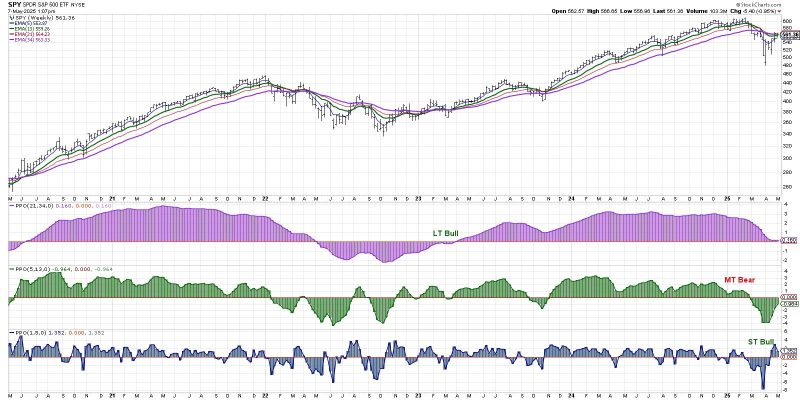
With all eyes and ears on this week’s Fed meeting, it’s worth taking a big step back to reflect on conditions related to momentum, breadth, and leadership. And while the rally of the early April lows has been significant, the S&P 500 and Nasdaq 100 now face considerable resistance at the 200-day moving average.
With that backdrop in mind, here are three charts we’re watching that have not yet signaled an “all clear” for risk assets.
Long-time market newsletter author Paul Montgomery used to point out that the most bullish thing the market can do is go up. The way we make this simple assessment of market trend is using our Market Trend Model.
As of last Friday’s close, our Market Trend Model shows a short-term bullish signal, given the strength off the early April low. The medium-term model, however, remains bearish, as the recent bounce is still defined as a bear market rally. If the S&P 500 can push above its own 200-day moving average, that would likely be enough to move the medium-term model to the bullish side for the first time since October 2023.
Over the years, I’ve found the Market Trend Model to be a fantastic way of separating the short-term “flickering ticks” of day-to-day market movements from the more significant shifts in sentiment from bullish to bearish. And by staying on the right side of this model, I’ve been able to capture most of the market upside, and more importantly, avoid disastrous bear phases!
Don’t miss our daily market recap show, CHART THIS with David Keller, CMT. We’ll track how these charts evolve through the course of the week, highlight key stocks on the move, and boil down the most important market themes from a technical perspective. Join us live every trading day at 5pm ET, or catch the replay on our YouTube channel!
While the S&P 500 and Nasdaq 100 are testing their own 200-day moving averages, many S&P 500 members are in a very similar position. At the April 2025 market low, less than 10% of the S&P 500 stocks were above their 50-day moving average. That reading has reached almost 60% this week as literally half of the S&P 500 members have regained this short-term moving average.
While the bottom panel shows the percent of stocks above the 50-day moving average, the next panel up displays the percent of S&P 500 members above their 200-day moving average. While this has also increased over the last month, it still remains below 50%.
The countertrend rally in March 2025 saw this indicator go up to 50% and then reverse lower, providing a warning sign of further lows to come. Will we see a similar stall in this indicator in May 2025? If so, that could indicate a retest of the April low. On the other hand, if both of these gauges push above 50%, then investors should brace for much further upside for the S&P 500.
Leadership themes could become incredibly important, as many leading growth stocks remain in a position of technical weakness. And unless the top growth stocks go into full rally mode, it’s hard to imagine meaningful upside for the S&P 500 and Nasdaq 100. One way to consider this relationship is to chart the ratio between Consumer Discretionary and Consumer Staples.
The top panel shows the cap-weighted sector ETFs, and the bottom panel shows the same ratio using equal-weighted sector ETFs. Both of these ratios made a major peak in Q1 2025, and both of them trended lower into a mid-April low. Over the last three weeks, we’ve seen a dramatic upside reversal in these offense-defense rations, indicating a rotation from defensive to offensive positioning.
Quite simply, I don’t see the major averages pushing higher unless these ratios continue to gain ground to the upside. We have observed strength in some Consumer Staples names, from Kroger (KR) to Coca Cola (KO), but it would take charts like Amazon (AMZN) making a significant move higher to give the S&P 500 any real chance of pushing above its own 200-day moving average. This ratio moving higher would confirm that “things you want” are outperforming “things you need”, and that has bullish implications for risk assets.
Investors are facing more uncertainty than ever as we brace for the latest Fed announcement, the newest tariff headline, and mixed results in the form of economic indicators. By watching charts like these, and keeping a watchful eye on the updated Market Summary page, StockCharts users can approach these markets with confidence.
RR#6,
Dave
P.S. Ready to upgrade your investment process? Check out my free behavioral investing course!
David Keller, CMT
President and Chief Strategist
Sierra Alpha Research LLC
Disclaimer: This blog is for educational purposes only and should not be construed as financial advice. The ideas and strategies should never be used without first assessing your own personal and financial situation, or without consulting a financial professional.
The author does not have a position in mentioned securities at the time of publication. Any opinions expressed herein are solely those of the author and do not in any way represent the views or opinions of any other person or entity.
The S&P 500 ($SPX) wrapped up Tuesday just below its intraday midpoint and posted one of the narrowest ranges we’ve seen in the past two months. That’s a clear sign traders are reluctant to take major bets ahead of Wednesday’s 2:00 PM ET Federal Open Market Committee (FOMC) decision.
And honestly, this caution makes sense. If we look back at how the stock market has reacted following the first two FOMC meetings of 2025, there has been a mix of hesitation and sharp moves.
Below is an updated chart marking each FOMC date since 2024 alongside the S&P 500. After the late January meeting, the S&P 500 zig-zagged to marginal new highs over the next two weeks before the first of two sharp down legs unfolded.
FIGURE 1. FOMC DATES SINCE 2024.
Coincidence or not, the S&P 500 is trading at nearly the same price level now, six weeks later, as it was back then. So, how close are today’s prices compared to the close on March 18, the day before the last Fed meeting?
This close (see chart below):
FIGURE 2. THE S&P 500 IS TRADING VERY CLOSE TO LAST FOMC MEETING LEVELS.
The difference is that the index has been rallying for four weeks, starting from the pivot low on April 7, a month ago today. In March, the S&P 500 was trying to bounce after topping four weeks earlier on February 19. That bounce continued for a few more days before dominant down-trending price action took over.
But over the last few weeks, the dominant trend is definitely higher. So the big question now is: can this mini uptrend resume after this pause?
A few days ago, the 14-period relative strength index (RSI) on the two-hour chart grazed the 70-overbought level for the first time since late January (see chart below). Yes, it took a nearly 18% rally in a very short time frame for it to finally happen, but remember, the indicator was coming off its lowest level since the COVID lows. Modest 3–5% pops were enough to trigger overbought readings for much of 2024. Not this time.
As you know, overbought conditions never persist, especially in very short timeframes like this. However, if this rally has anything left in the tank, we’ll see the indicator hit overbought again soon. That may not happen in the next day or two, but if the market reacts negatively to today’s news, but a bid returns soon after, it could keep some of the bullish patterns we’ve been tracking in play. That’s just one scenario, but one we’ll be closely watching.
FIGURE 3. TWO-HOUR CHART OF THE S&P 500.
There are two bullish pattern breakouts still in play on the S&P 500 chart:
And barring a very extreme and negative reaction, the patterns will stay alive today, as well.
FIGURE 4. INVERSE HEAD-AND-SHOULDERS AND CUP WITH HANDLE PATTERNS.
FIGURE 5. INVERSE HEAD-AND-SHOULDERS PATTERN IN THE S&P 500.
FIGURE 6. CUP WITH HANDLE PATTERN IN THE S&P 500.
The Utilities Select Sector SPDR Fund (XLU) was the first sector ETF (and one of the first of all the ETFs we track) to notch a new 50-day high, which it hit on Tuesday. On the weekly chart, it’s clear the ETF is now trying to leverage a multi-month bottoming formation.
This is especially notable because the formation has developed above two bullish pattern breakouts from 2024. Ironically, XLU’s first major breakout of 2024 happened around this time last year (late April), which set the stage for an extremely strong run, at least through late November.
The current snapback is important to watch, given how well XLU has recently capitalized on bullish breakouts. Some upside follow-through from here would also put the former highs back in the crosshairs.
FIGURE 7. WEEKLY CHART OF UTILITIES SELECT SECTOR SPDR (XLU).
Invesco Solar ETF (TAN) has been rallying since the April lows, much like nearly every ETF we track. On the daily chart, it’s been trying to leverage a bullish cup and handle pattern, a formation we’ve also seen emerge in many other areas. It’s coming off an extremely oversold condition, with its 14-week RSI undercutting 30 for just the third time since 2021. So TAN could see some additional upside from here.
But the ETF will need to do much more to materially improve its long-term technical picture. Nearly every rally has stalled near the key weekly moving averages, all of which continue to slope lower. Selling strength in TAN has been a highly effective strategy since it peaked in early 2021.
FIGURE 8. WEEKLY CHART OF INVESCO SOLAR ETF (TAN).
Bitcoin has held its breakout from two weeks ago quite well so far. The next upside target remains near 103k. Again, regardless of whether or not you follow crypto, seeing the bid continue is a bullish sign for risk appetite across different asset classes, especially equities.
Fun fact: Bitcoin topped a few weeks before the SPX, so it can be a useful leading indicator.
FIGURE 9. BITCOIN BREAKS OUT.
While Ethereum’s extreme relative weakness vs. Bitcoin has continued, it too has rallied over the last few weeks. It’s now close to breaking out from a cup with handle formation. At the same time, it’s testing its now flat 50-day moving average.
The combination of a bullish breakout and a move through the 50-day moving average produced a very strong follow-through rally in November, something Ethereum will try to replicate.
FIGURE 10. ETHEREUM BREAKS ABOVE 50-DAY MOVING AVERAGE.
As we head into the Fed decision, we’re seeing a lot of cautious optimism in the charts. Key bullish patterns are still holding, sectors like Utilities are showing strength, and crypto is flashing green.
The next few sessions will be important. If we get a knee-jerk reaction to the Fed, but buyers step in quickly it could set the stage for the next leg higher in this rally.
Stay alert.
Frank Cappelleri is the founder and president of CappThesis, an independent technical analysis newsletter firm. Previously, Frank spent 25 years on Wall Street, working for Instinet, the equity arm of Nomura and Smith Barney. Frank’s various roles included being an equity sales trader, technical analyst, research sales specialist and desk strategist. Frank holds the CFA and CMT designations and is a CNBC contributor.
https://www.youtube.com/@cappthesis
https://twitter.com/FrankCappelleri/
https://www.linkedin.com/in/frank-cappelleri-cfa-cmt-a319483/

The stock market’s action on Wednesday was a bit like trying to pick a dinner spot with friends—lots of back and forth, but no real direction.
The market started out higher and went up and down without much of a directional bias until the Fed made its expected interest rate decision and Fed Chairman Jerome Powell’s press conference. Stock prices dipped lower, but right before the close, another headline moving event surfaced: President Trump announced the rollback of some chip-related restrictions. This news gave the market a boost into the close.
Here’s how the broader indexes closed:
In terms of sector performance, Technology came out on top, followed by Consumer Discretionary and Health Care. On the flip side, Real Estate, Communication Services, and Materials were the laggards.
The main reason behind the stumble in Communication Services was Alphabet, Inc. (GOOGL), which dropped by a whopping 7.26%. Why the selloff? An Alphabet exec testified that Google was losing search traffic to AI tools.
The StockCharts’ S&P 500 MarketCarpet (below) reflects Wednesday’s price action.
FIGURE 1. STOCKCHARTS MARKETCARPETS FOR MAY 7, 2025. It was mostly green with some pockets of red.Image source: StockCharts.com. For educational purposes.
Overall, Wednesday’s performance is leaning more positive than negative, but is it enough to break through critical resistance levels?
To get a clearer picture, we need to check out the daily chart of the S&P 500 ($SPX).
FIGURE 2. S&P 500 FACING A LOT OF HEADWINDS. THE 61.8% Fibonacci retracement level is a resistance level the index is struggling to break above.Chart source: StockCharts.com. For educational purposes.
The S&P 500 is sandwiched between its 50- and 200-day simple moving averages (SMAs). The Fibonacci retracement levels drawn from the February high to April low show that the 61.8% retracement level is proving to be a stubborn ceiling. Add to that the downward-sloping 50-day SMA, and the market may have a tough time moving higher. To leave the downtrend in the rearview mirror, the S&P 500 would have to break above its 200-day SMA with the necessary follow-through to keep it above that level. So far, the price action suggests that the S&P 500 will face headwinds to get to that stage.
Remember, the market’s price action is like riding a rollercoaster powered by headlines. This can sometimes send technical analysis into a disarray.
Take, for example, today’s news about lifting the chip restrictions, which sent semiconductor stocks higher. The VanEck Vectors Semiconductor ETF (SMH) jumped 2.05% (see chart below).
FIGURE 3. DAILY CHART OF SMH. Will the semiconductor ETF be able to break out above its May 2 high?Chart source: StockCharts.com. For educational purposes.
Like the chart of the S&P 500, SMH needs to work harder at breaking its downtrend. The one ray of hope is that Wednesday’s move reached the May 2 high. The downside: it wasn’t able to break above it. This shows investors are cautious about semiconductors and the overall equity market.
The caution among investors can be seen clearly in the chart of the S&P 500 vs the Cboe Volatility Index ($VIX).
FIGURE 4. VIX VS. S&P 500. Even though the VIX pulled back from its April peak, it’s still above average.Chart source: StockCharts.com. For educational purposes.
What’s interesting is that while the VIX fell when the S&P 500 rose from mid-April, the VIX hasn’t dropped to its average level of 19. It’s still trading above it, which is another point that increases the probability of further downside in equities.
There is a lot going on: geopolitical tensions, trade deal updates, policy shifts. Any of these can jolt the market in either direction.
It was encouraging to see tech stocks and semiconductors bounce on Wednesday, but that doesn’t mean we’re headed back to the days of growth stock leadership. If you’re an investor, especially one managing retirement money or nearing retirement, the best approach is to be patient. We’re not out of the woods yet.
As always, stay alert and stick with your investment plan.
Disclaimer: This blog is for educational purposes only and should not be construed as financial advice. The ideas and strategies should never be used without first assessing your own personal and financial situation, or without consulting a financial professional.
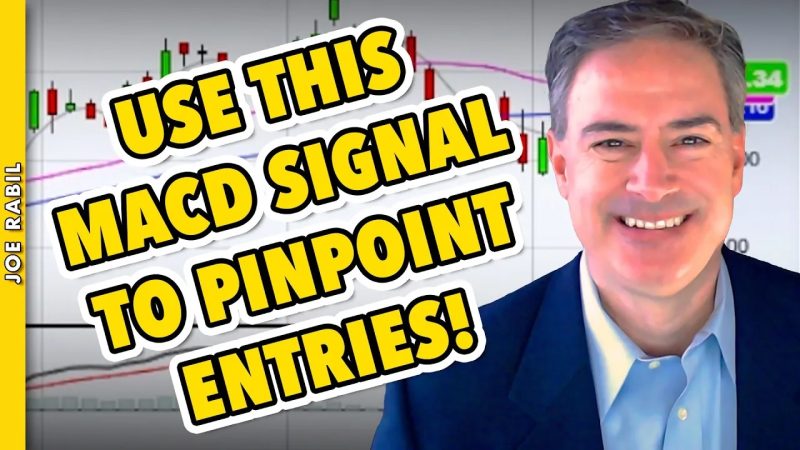
In this video, Joe shares how to trade MACD signals using multiple timeframes, and how to spot stock market pullback setups that can help to pinpoint a great entry off a low. He then reviews sector performance to identify market leadership, covers key chart patterns, and discusses a looming bearish signal on QQQ and IWM. The video wraps with technical analysis on popular viewer-submitted stock symbols, including REAL, PSTG, and more.
The video premiered on May 7, 2025. Click this link to watch on Joe’s dedicated page.
Archived videos from Joe are available at this link. Send symbol requests to stocktalk@stockcharts.com; you can also submit a request in the comments section below the video on YouTube. Symbol Requests can be sent in throughout the week prior to the next show.
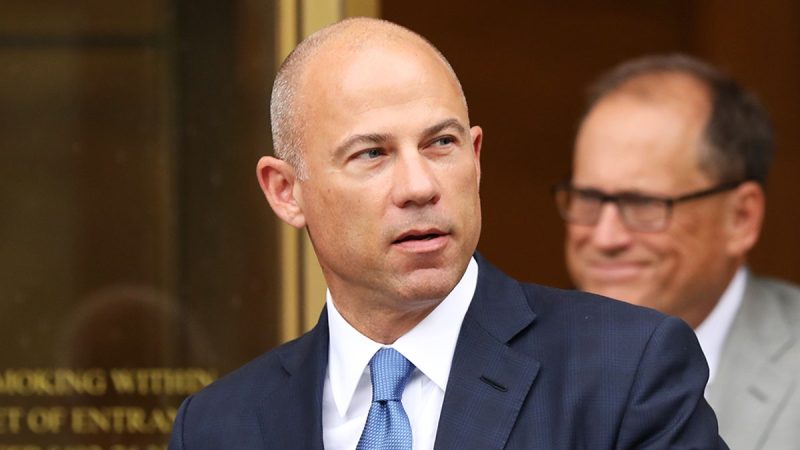
Disgraced lawyer Michael Avenatti says life behind bars has changed him into a better person and is asking a federal judge to consider that personal transformation when he gets resentenced on May 27.
Avenatti was originally sentenced to 14 years in prison after pleading guilty to defrauding clients of millions of dollars and hiding millions more from the IRS. He appealed that sentence, and a new hearing was ordered by the Ninth Circuit Court of Appeals, which said the trial judge erred by ultimately giving Avenatti a too-lengthy sentence.
‘Since his 2022 original sentencing, [Avenatti] has lived every day of his incarceration seeking to atone for the harm he caused and set his life on a different path,’ Avenatti’s lawyers wrote on Tuesday in their 41-page argument for a more lenient sentence.
That filing offers details about Avenatti’s life at the Terminal Island prison in Los Angeles. They described how Avenatti is trusted by prison officials to help other inmates – including serving as ‘suicide watch companion.’ He also completed a drug abuse program and ‘regularly attended AA meetings and religious services.’
Avenatti’s lawyers also included an internal Bureau of Prisons report, which says he ‘has been a model inmate….[and] has distinguished himself through his work in the library, where he has voluntarily assisted academically challenged inmates with legal matters.’
The lawyers also claim Avenatti’s prison behavior is a true reflection of his character and done without regard to the upcoming resentencing hearing. ‘His actions demonstrate remorse, rehabilitation, and a strong desire to become a source of positive change,’ they wrote.
Federal guidelines allow for judges to consider an inmate’s good deeds behind bars when resentencing. Prosecutors argue Avenatti is still the same shady lawyer – now disbarred – and still deserves a long sentence.
‘Defendant’s egregious violations of his duties and the trust placed in him by his clients, his infliction of great harm by stealing millions of dollars from them, and his greed and arrogance leading to the calculated choices and deception that he carried out for years against his clients and the IRS, all remain the same,’ Assistant U.S. Attorneys Brett Sagel and Ranaee Katzenstein wrote in their filing submitted early Wednesday morning.
Avenatti’s release date is currently set for July 31, 2035. He is asking U.S. District Court Judge James Selna for a sentence that would have him released in just a few years. Prosecutors are asking for a sentence of only a few months less than the 14 years originally handed down.
Both filings offer detailed arguments about the different factors they want Selna to reconsider at the upcoming hearing, including determinations about how to properly assess how much money Avenatti’s clients actually lost. Those technical determinations are significant as they influence the severity of the sentence. In essence, as the financial amounts increase, so does the sentence. The appellate court ruled Selna miscalculated some of those losses at the original sentencing hearing.
‘Mr. Avenatti acknowledges that nothing can change how much he hurt the former clients he was entrusted to help,’ federal public defender Margaret Farrand wrote about her client. ‘Nothing can change the shame he still feels. But Mr. Avenatti has tried his best to show that his remorse and concern for others are real, not through his words, but through his actions while in custody.’
This case is separate from Avenatti’s other convictions for attempting to extort Nike and stealing money from his most famous client, Stormy Daniels. Avenatti’s attempts to get those convictions and sentences overturned on appeal all failed.

WASHINGTON — Vice President JD Vance said that the concessions that Russia is seeking from Ukraine to end the conflict between the two are too stringent, but he believes there is a viable path forward for peace and wants both to find common ground.
‘The step that we would like to make right now, is we would like both the Russians and the Ukrainians to actually agree on some basic guidelines for sitting down and talking to one another,’ Vance said here Wednesday at the Munich Leaders Meeting in Washington.
‘We think that if cool heads prevail here, we can bring this thing to a durable peace that will be economically beneficial for both Ukrainians and the Russians,’ Vance said.
Vance appeared for a discussion with Ambassador Wolfgang Ischinger, president of the Foundation Council of the Munich Security Conference and the former German ambassador to the U.S.
Russia’s demands include Ukraine never joining NATO, and preventing foreign peacekeeper troops from deploying to Ukraine following the conflict. Additionally, Russia is seeking to adjust some of the borders that previously were Ukraine’s.
Additionally, Ukraine is on board with a 30-day ceasefire, while Russia refuses to participate. Vance said that the U.S. is seeking to find solutions beyond the ceasefire.
‘We’ve tried to move beyond the obsession with the 30-day ceasefire, and more on what the long-term settlement look like, and we’ve tried to consistently advance the ball,’ Vance said.
Vance has urged for European nations to bolster defense spending and increase European independence, aligning with the Trump administration’s ‘America First’ agenda that has pushed NATO allies to beef up their own military spending.
The event comes as Ischinger recently cautioned that any attempts to establish a peacekeeping force in Ukraine to end the conflict between Moscow and Kyiv absent the U.S. could mean the ‘de facto end of NATO,’ according to Politico.
Should the U.K. and France send a peacekeeping force there like they’ve both discussed without U.S. involvement, that could prompt Russia to accuse Ukrainians of starting a conflict, Ischinger said in a Politico interview published Monday.
‘And therefore the Europeans in Ukraine would possibly be shot at, and would need to reply, to engage without the United States on their side,’ Ischinger said. ‘Quite frankly, that would be the end of NATO as we know it.’
Vance previously appeared at the Munich Security Council in February, where he laid out the Trump administration’s stance that Europe ‘step up in a big way to provide for its own defense.’
He also cautioned that Russia and China don’t pose as great a threat to European nations as the ‘threat from within,’ in regard to issues like censorship and illegal immigration.
European leaders pushed back on the remarks at the time, with German Defense Minister Boris Pistorius said he perceived the comments as a comparison to ‘conditions in parts of Europe with those in authoritarian regimes.’
This is a breaking news story and will be updated.