Blackstone Minerals (BSX:AU) has announced Visible Gold Above High Grade Cu-Au Porphyry – Amended
Download the PDF here.
This post appeared first on investingnews.com



Blackstone Minerals (BSX:AU) has announced Visible Gold Above High Grade Cu-Au Porphyry – Amended
Download the PDF here.
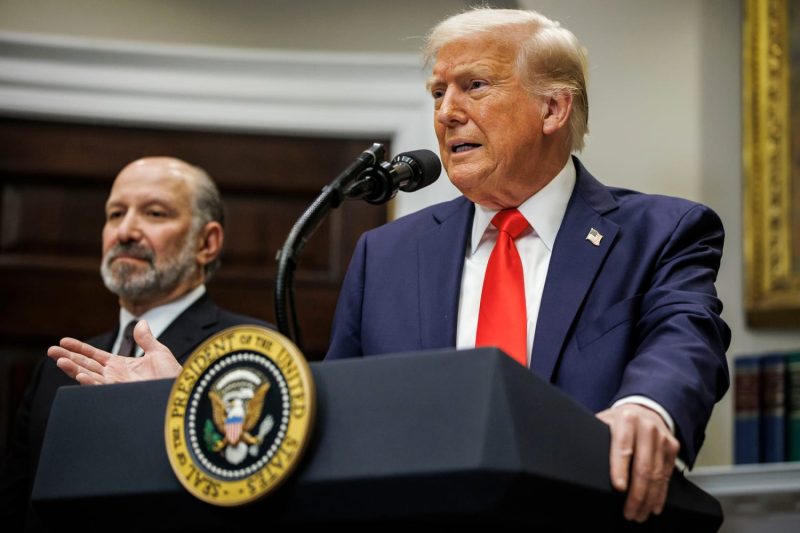
President Donald Trump will “probably” announce tariff compromise deals with Canada and Mexico soon, Commerce Secretary Howard Lutnick said Tuesday.
The potential agreements would likely involve scaling back at least part of Trump’s brand new 25% tariffs on imports from Mexico and Canada, he added.
Lutnick’s comments came minutes after the U.S. stock market limped to a close for a second day of sharp declines, spurred at least in part by investors’ fears that Trump’s aggressive policies will ignite a crippling trade war.
The compromise with Canada and Mexico will likely be revealed as soon as Wednesday, Lutnick said on “Fox Business.”
While the Cabinet secretary did not specify what Trump would agree to, he suggested the U.S. president would be willing to meet Canada and Mexico “in the middle.” He also appeared to foreclose on the possibility that Trump would lift the tariffs entirely.
The Trump administration on Tuesday reimposed sweeping 25% tariffs on Canadian and Mexican imports after putting them on pause for a month.
Trump, who has held up tariffs as an all-powerful negotiating tool, based the policy on allegations that the neighboring countries were failing to stem the flow of drugs and crime into the U.S.
“Both the Mexicans and the Canadians are on the phone with me all day today, trying to show that they’ll do better,” Lutnick said Tuesday afternoon.
“And the President is listening because, you know, he’s very, very fair and very reasonable. So I think he’s going to work something out with them,” he said.
Lutnick described a deal in which Canada and Mexico agree to “do more,” at which point Trump would “meet you in the middle some way.”
“We’re going to probably be announcing that tomorrow,” he said.
Lutnick said the announcement would not be another pause.
The comments came hours before Trump was set to deliver a primetime address to a joint session of Congress.
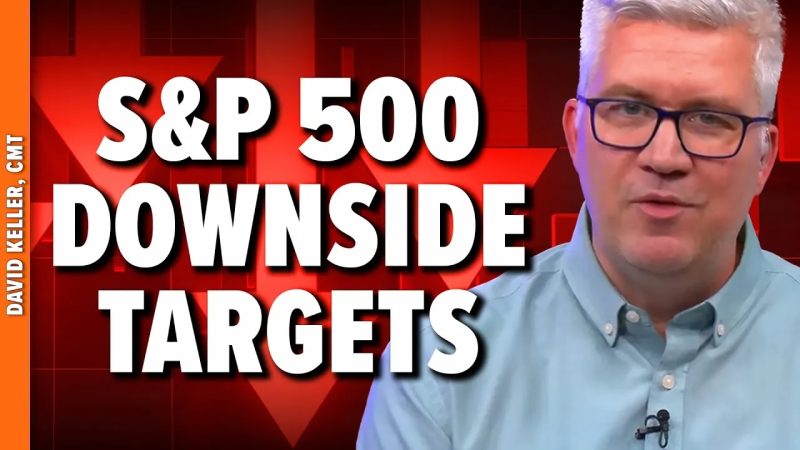
In this video, Dave analyzes market conditions, bearish divergences, and leadership rotation in recent weeks. He examines the S&P 500 daily chart, highlighting how this week’s selloff may confirm a bearish rotation and set downside price targets using moving averages and Fibonacci retracements. To validate a potential end to the bearish phase, he shares a key technical analysis chart. What’s your S&P 500 downside objective?
This video originally premiered on March 4, 2025. Watch on StockCharts’ dedicated David Keller page!
Previously recorded videos from Dave are available at this link.

In this exclusive StockCharts video, Julius analyzes seasonality for U.S. sectors and aligns it with current sector rotation. He explores how these trends impact the market (SPY) and shares insights on potential movements using RRG analysis. By combining seasonality with sector rotation, he provides a deeper look at market pressure and what to watch next.
This video was originally published on February 28, 2025. Click on the icon above to view on our dedicated page for Julius.
Past videos from Julius can be found here.
#StayAlert, -Julius
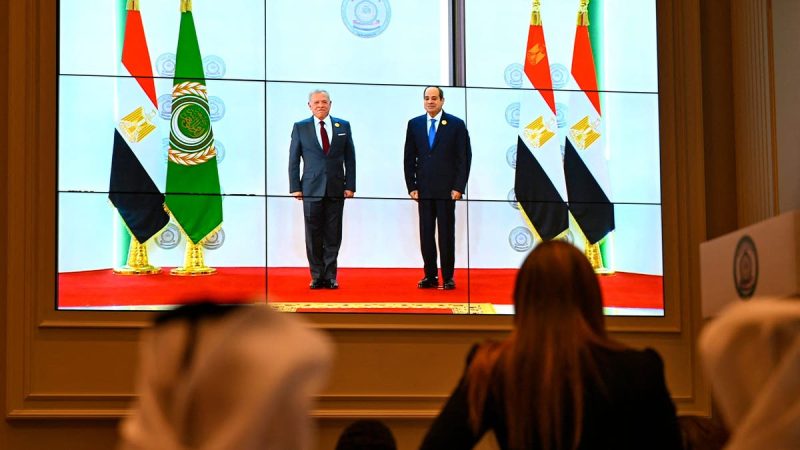
Arab leaders convened in Cairo on Tuesday for an emergency summit aimed at presenting a counterproposal to President Donald Trump’s Gaza plan. The summit was held to discuss Egypt’s $53 billion comprehensive reconstruction blueprint for Gaza.
Before Trump proposed resettling Gazans outside the enclave, Egypt and other Arab states had shown little interest in Gaza’s reconstruction. However, given that Egypt has ruled out accepting displaced Palestinians for ‘national security’ reasons, it now finds itself compelled to devise its own plan.
With a $53 billion price tag, the plan is positioned as an alternative to Trump’s vision, and key details have already been shared by Arab media outlets. While Egypt proposes a temporary committee to manage Gaza for six months, Palestinians have made it clear that they will not accept any governing body that isn’t Palestinian or any foreign forces within Gaza. The plan is projected to take at least four and a half years.
The Egyptian plan is divided into two phases: the first, lasting two years and costing around $20 billion, and the second, spanning two and a half years with a $30 billion allocation. The funds will primarily go toward rebuilding residential areas devastated by conflict.
Importantly, the plan does not call for the displacement of Gaza’s residents, as Trump’s proposal does, and stresses the importance of Palestinian-led reconstruction efforts, and that the Palestinian Authority will collaborate with Egypt and Jordan to train a police force for Gaza. But Hamas has already rejected the plan, and the Palestinian Authority has made it clear that it will not engage in reconstruction efforts as long as Hamas maintains control.
‘The Saudis will fund Gaza if there’s a path to a Palestinian state and Hamas is gone,’ Ghaith Al-Omari, senior fellow at the Washington Institute and former executive director of the American Task Force on Palestine told Fox News Digital, ‘Saudi Arabia, the UAE, and Qatar want something from the Israelis in return, whether it’s an end to the war or security agreements. They’ll insist on a role for the Palestinian Authority, even if symbolic, for diplomatic reasons. The question is whether the current Israeli government can meet these demands.’
‘A militarized Hamas cannot remain in Gaza – the strip must be demilitarized, and Hamas must no longer be in control. The Emiratis are even more extreme on this issue,’ Danny Zaken, a senior commentator for Israel Hayom newspaper, told Fox News Digital, ‘The final draft of the Egyptian plan will avoid directly addressing Hamas. Instead of stating that Hamas will be removed and disarmed, it will say that ‘qualified Palestinian security forces will maintain order with Egyptian backing.’ This approach aims for unanimous approval without addressing Hamas’ fate, but the reality is that it has no practical validity, because in that case the plan has no financial backing,’ he explained.
Al-Omari observed, ‘Arab League summits tend to be a lot of posturing. Who’s going to take care of security? The PA can’t handle that – they’re too weak. No Arab country wants to send troops to Gaza, but they’re also under pressure from the U.S. to contribute.’
An Egyptian diplomatic source told Fox News Digital that Egyptian construction firms are ready to begin work, but the real challenge is political. ‘Egyptian construction companies are very capable, and they can rebuild Gaza in three years – if there is political will, mainly from Israel and the U.S.,’ the source said.
While Egypt is eager to lead the reconstruction process, its ambitions have created friction with key Gulf states, which are expected to finance much of the effort. Zaken, noted, ‘The Saudis are concerned because the Egyptians want to control the entire process: Who gets the money, who oversees the reconstruction, who the contractors are for demolition and rebuilding? And even new housing and hotels. The other partners worry about corruption in the process.’
A former U.S. foreign service official warned Fox News Digital that Egypt’s ability to manage such funds is a concern. ‘The Gulf, which is expected to pay for it, is sick and tired of Egyptian corruption. If they fund the reconstruction, they will demand major oversight to ensure the money doesn’t get lost in Egypt’s power structure,’ the source said.
Meanwhile, Jordan, which has played a key diplomatic role, has managed to avoid direct involvement in the reconstruction debate. Following King Abdullah’s meeting with Trump, Jordanian officials felt that the pressure had shifted to Egypt and other Arab states. ‘The Jordanians were very happy with the outcome of the meeting with Trump. They feel that the pressure to accept [a] million Gazans is off them,’ Al-Omari said.
At the same time, the broader political future of Gaza remains uncertain. Al-Omari noted that despite the ongoing reconstruction discussions, the primary concern for Arab leaders is how to navigate Trump’s unpredictable stance on Gaza. ‘Frankly, the main thinking in Arab governments right now is how to engage in a covert process with Trump to walk him back from this. No one expects immediate results, but they do hope that this will move Trump away from the idea of depopulating Gaza,’ he said.
For now, all eyes are on the summit. However, as one former diplomatic source put it, ‘There’s no real plan yet – just ideas. Everyone is trying to shape it in their favor, but until Hamas’ fate is resolved, we’re all just talking in circles.’

With US tariffs on Canada, Mexico, and China having taken effect at midnight on Tuesday, US indexes extended their Monday losses, deepening concerns over the escalating trade war.
It was only a few months ago when analysts held relatively optimistic forecasts of emerging and developed market performance relative to the US. Since Trump’s re-election, Wall Street has grown more cautious due to renewed trade tensions, particularly with China, Canada, and Mexico. Nevertheless, given the sharp decline in US stocks, I thought it might be prudent to examine international markets to see how emerging and developed markets might be responding to the new Trump trade war.
Here’s a MarketCarpets view of the action early Tuesday morning:
FIGURE 1. MARKETCARPETS ONE-DAY VIEW OF INTERNATIONAL MARKETS. It’s a mixed bag with mostly negative responses.Image source: StockCharts.com. For educational purposes.
As expected, iShares MSCI Canada ETF (EWC) and iShares MSCI Mexico Capped ETF (EWW) are down while iShares MSCI China ETF (MCHI) remained resilient in the early part of the trading session.
For a broader yet short-term perspective, the five-day view shows a similar trend, but with deeper losses.
FIGURE 2. FIVE-DAY VIEW OF MARKETCARPETS INTERNATIONAL MARKETS. No clear leadership here with developed and emerging markets largely declining across the board.Image source: StockCharts.com. For educational purposes.
Developed and emerging markets are largely in the red with no clear leadership. What markets are bracing for are the tariff responses, which could significantly complicate and negatively impact global trade dynamics.
For those of you who might not be aware of it, the “developed” category excludes US markets. This may seem as strange as China’s inclusion in the “emerging” category where it is the second largest economy in the world. But there you have it. So, to get a clear picture of relative performance between the US markets, developed markets, and emerging markets, we’ll look at three ETFs representing each category and compare their performance using a one-year view on PerfCharts.
FIGURE 3. PERFCHARTS COMPARING RELATIVE PERFORMANCE OF DEVELOPED MARKETS, EMERGING MARKETS, AND THE S&P 500. The S&P and emerging markets are declining, but developed markets are rising and holding steady.Chart source: StockCharts.com. For educational purposes.
To get an even clearer, if not more direct comparison, take a look at a weekly ratio chart comparing EFA with EEM. From here on out, we’ll be focusing solely on international markets (omitting the S&P 500).
FIGURE 4. CHART OF EFA:EEM WITH GUPPY MULTIPLE MOVING AVERAGES. Notice how the short- and longer-term market sentiment is in an uneasy equilibrium.Chart source: StockChartsACP.com. For educational purposes.
What’s valuable about plotting a Guppy Multiple Moving Average (GMMA) is that its two color-coded ribbons are proxies for short and long-term investors. Developed markets have been trending strongly against emerging markets since the summer of 2021. But now, with the two ribbons converging, it’s telling you that short- and long-term sentiment is hovering at an uneasy equilibrium. There’s still plenty of uncertainty, even with developed markets pulling ahead.
Despite the global trade environment, might EFA or EEM present any tradable opportunities from a technical perspective? Let’s shift over to a daily chart of EFA for a closer look.
FIGURE 5. DAILY CHART OF EFA. A wide trading range with a few indications of a potential breakout.Chart source: StockCharts.com. For educational purposes.
EFA is trading near the top of a wide trading range. If you were to look at a naked chart of EFA, the price action would seem a little chaotic. This is why I decided to plot the following indicators to contextualize the price action. As complex as it may look, the indicators make the price action simpler to understand.
Here are a few key points to consider:
If this looks semi-bullish, EEM looks a bit more stuck. Here’s a daily chart.
FIGURE 6. DAILY CHART OF EEM. Support and resistance levels are plotted in an otherwise messy trading range.Chart source: StockCharts.com. For educational purposes.
EEM has sharply declined after falling below the bullish SCTR threshold of 70. After failing to retest its September high, it has retraced back toward the middle of a range that extends as far back as May of last year. The most concentrated portion of that range, as shown by the Volume-by-Price, lies between $41.50 and $43.50. While the ADL signals positive buying pressure relative to the decline in price, it’s also flattening out, indicating that money flows may be steadily declining.
Despite the volatile price action, support and resistance levels remain well-defined (and the Volume-by-Price indicator helped confirm these levels). EEM is likely to bounce between support ($41 and $42) and resistance ($43.50 and $45.50) unless macroeconomic catalysts trigger a breakout in either direction below or above the current range. For now, patience is key—waiting for EEM to establish a clearer direction, technically or fundamentally.
Here are a few things you can do:
Given the heightened uncertainty surrounding global trade, developed markets have shown relative strength, while emerging markets remain in a fragile position. With tariff responses still unfolding, you should stay alert to price action while monitoring broader market sentiment for signs of directionality. For now, patience and observation remain key in navigating these volatile markets.
Disclaimer: This blog is for educational purposes only and should not be construed as financial advice. The ideas and strategies should never be used without first assessing your own personal and financial situation, or without consulting a financial professional.
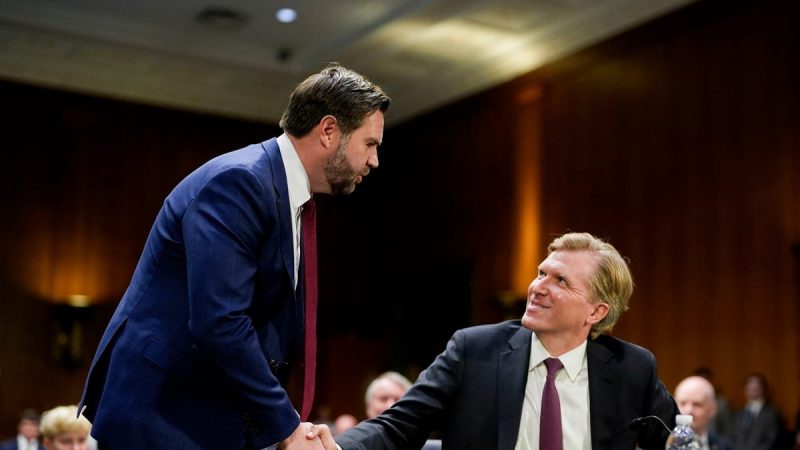
Vice President JD Vance visited Capitol Hill to offer a message of support for his ‘friend,’ Elbridge ‘Bridge’ Colby, President Donald Trump’s contentious nominee for the Pentagon’s No. 3 spot, undersecretary of defense for policy.
In so many ways, Bridge predicted what we would be talking about four years down the road, five years down the road, 10 years down the road. He saw around corners that very few other people were seeing around,’ Vance said in opening remarks Tuesday at Colby’s confirmation hearing before the Senate Armed Services Committee.
‘If you look at his long career in defense policy, he has said things that, you know, frankly, alienated Democrats and Republicans. He’s also said things that I think both Democrats and Republicans would agree with,’ Vance continued.
The vice president praised Colby as a ‘good man’ and an ‘honest man.’
‘You need people who are going to tell you the truth. We’re going to look you in the eye who are going to disagree,’ Vance said.
The vice president’s presence demonstrates how seriously the White House is looking to shore up support for Colby, whose restraint-minded views have given pause to some more hawkish senators.
It is the second confirmation hearing Vance has attended after Commerce Secretary Howard Lutnick, who the vice president also has a close relationship with.
Colby said in his own opening remarks, ‘There is a real risk of major war, and we cannot afford to lose one. I recognize these realities in my bones. It is my great hope that we can get through the coming years peacefully, with strength in ways that put us and our alliances on a stronger and more sustainable footing.’
‘I’m willing and ready to engage with those who disagree with me and adapt my views based on persuasive arguments and the fact is that I value our alliances deeply, even as I think they must be adapted, and that I love our great country, and will put its interests first and foremost.’
Senate Armed Services Committee Chair Roger Wicker, R-Miss., questioned Colby on his previously stated position, ‘America has a strong interest in defending Taiwan, but Americans can survive without it.’
‘our views on Taiwan’s importance to the United States seems to have softened considerably,’ Wicker told Colby.
Colby disputed that point, arguing he had been shooting a warning flare that the U.S.’ ‘military balance has declined’ with regard to China.
‘What I have been trying to shoot a signal flare over is that it is vital for us to focus and enable our own forces for an effective and reasonable defense of Taiwan and for the Taiwanese, as well as the Japanese to do more,’ said Colby.
‘So my position in terms of the value of Taiwan is consistent. But what I’m very fearful of, Senator, and I think this is agreed across administrations of both parties, is that, you know, the military balance has declined. So I’m trying to avoid a situation of which, because we are not adequately prepared.’
Sen. Jack Reed, the top Democrat on the committee, pressed Colby on his views on Russia and Ukraine.
‘In November 2023, you said, ‘The invasion of Ukraine is an evil act by the Russians, and I morally support the Ukrainian defense.’ Do you still agree with that statement?’ asked Reed, D-R.I.
‘I think I stand by my record, but at this point, I think, there’s a very delicate diplomatic process going on where the president is rightfully trying to resuscitate the peace process. And I don’t think it’d be appropriate for me to weigh in,’ said Colby.
Sen. Kristen Gillibrand, D-N.Y., pressed Colby on whether Russia was an ‘adversary’ or an ‘ally’ to the U.S.
‘Russia presents a significant military threat to Europe, and there are significant military threats to the homeland as well,’ said Colby. ‘We can… diminish, you know, the potential for direct confrontation with Russia in the same way with China.’
Colby’s confirmation process has rankled Iran hawks, and at least Sen. Tom Cotton, R-Ark., has privately expressed skepticism. Wicker previously told Roll Call that Colby’s nomination poses ‘a concern to a number of senators.’
Colby, who worked at the Pentagon during Trump’s first term and was a lead author on the 2018 U.S. National Security Strategy, has long asserted the U.S. should limit its resources in the Middle East and refocus on China as the bigger threat.
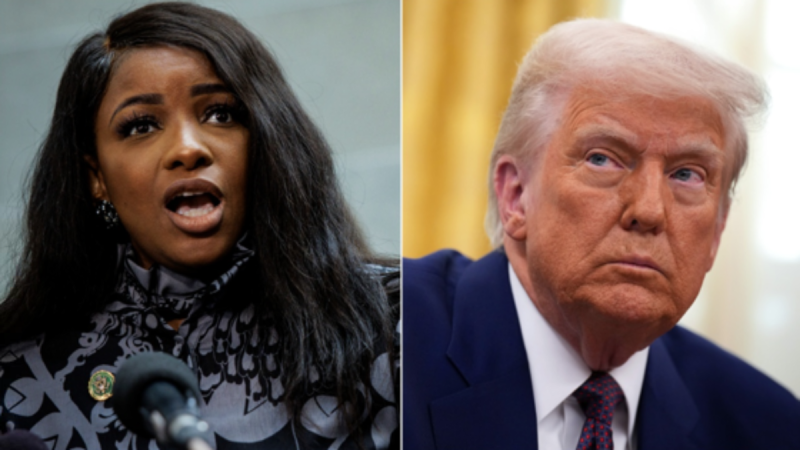
Democratic Rep. Jasmine Crockett was ripped by conservatives on social media this week after claiming President Donald Trump is ‘occupying the White House’ and is an ‘enemy to the United States.’
‘Unfortunately, we have someone that is occupying the White House, and as far as I’m concerned, he is an enemy to the United States,’ Crockett said on MSNBC on Sunday. ‘I don’t know what it’s going to take to get people to wake up.’
The Texas congresswoman also suggested that Trump is a ‘dictator’ in her cable news appearance.
Conservatives on social media quickly pushed back against Crockett.
‘Almost sounds like this ‘defender of democracy’ would support an insurrection,’ Fox News host Laura Ingraham posted on X.
‘When are we going to hold members of Congress accountable for their words and actions?’ retired professor Carol Swain posted on X.
‘Dangerous election denier stuff here,’ former Rep. Matt Gaetz, R-Fla., posted on X.
‘By all means, continue this leaderless, tired charade and keep losing elections,’ Sen. Markwayne Mullin, R-Okla., posted on X.
‘Yeah, she’s running in 2028,’ Red State writer Bonchie posted on X.
‘Jasmine Crockett labeled Trump as an enemy of America while simultaneously saying she doesn’t understand anything that’s going on,’ conservative influencer account Gunther Eagleman posted on X. ‘She’s really this dumb.’
‘The unquestioned leader of the Democratic Party,’ CNN commentator Scott Jennings posted on X. ‘Keep going!’
Fox News Digital reached out to Crockett’s office for comment but did not immediately hear back.
Crockett has become one of the most prominent faces of the Democratic Party, opposing Trump’s agenda and the DOGE efforts of Tesla CEO Elon Musk.
Crockett recently sparked a frenzy on social media when she told a reporter outside the U.S. Capitol that if she could tell Musk one thing it would be, ‘F— off.’

The Department of Government Efficiency (DOGE) on Tuesday announced the cancelation of $4.5 million in grants, including one for alpaca farming in Peru, another for reducing social discrimination of recyclers in Bolivia and another for promoting cultural understanding of Venezuelan migrants in Brazil.
The Inter-American Foundation, an agency given a $60 million budget to issue foreign grants, was reduced to its statutory minimum — one active employee, according to a statement from DOGE.
Grants that were canceled in the process included $903,811 for alpaca farming in Peru, $364,500 to reduce social discrimination against recyclers in Bolivia, and $323,633 to promote cultural understanding of Venezuelan migrants in Brazil, according to DOGE.
Other big ticket grants that were slashed included $813,210 for vegetable gardens in El Salvador, $731,105 to improve the marketability of mushrooms and peas in Guatemala, $677,342 to expand fruit and jam sales in Honduras, $483,345 to improve artisanal salt production in Ecuador and $39,250 for beekeeping in Brazil.
DOGE, led by Elon Musk, is a temporary organization within the White House created via executive order earlier this year.
President Donald Trump tasked the organization with optimizing the federal government, streamlining operations, and slashing spending — and gave them just 18 months to do it.
As of March 4, DOGE’s website claims 2,334 contract terminations totaling $8 billion in savings, 3,489 grant terminations for roughly $10 billion in savings, and 748 lease terminations totaling about $660 million in lease savings.
It also claims to have saved about $105 billion from a ‘combination of fraud detection/deletion, contract/lease cancelations, contract/lease renegotiation, asset sales, grant cancelations, workforce reductions, programmatic changes and regulatory savings.’
DOGE critics allege the organization has too much access to federal systems and should not be permitted to cancel federal contracts or make cuts at various agencies.
It canceled numerous diversity, equity and inclusion (DEI) initiatives at federal agencies, consulting contracts, leases for underused federal buildings, and duplicate agencies and programs.
The Inter-American Foundation did not immediately respond to Fox News Digital’s request for comment on Tuesday.
Fox News Digital’s Eric Revell contributed to this report.
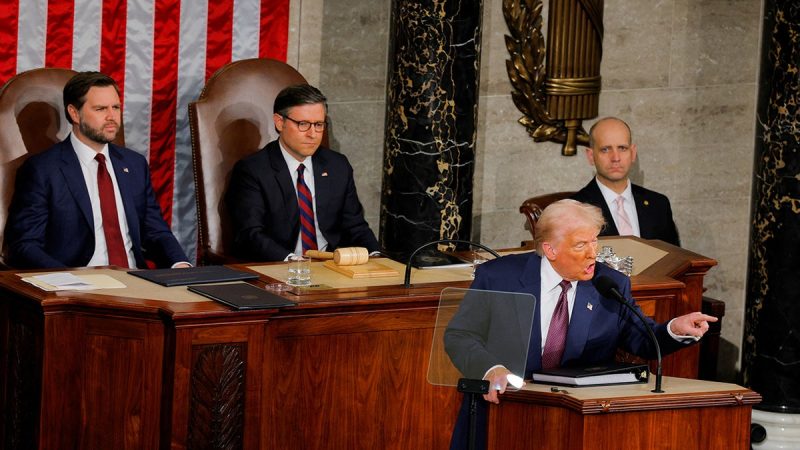
President Donald Trump promised to ‘make America affordable again’ by reducing the cost of energy during his joint address to Congress Tuesday night.
Speaking in the U.S. Capitol, Trump said that he was ‘fighting every day’ to ‘reverse’ the economic damage that he blamed on his predecessor, former President Joe Biden.
‘Joe Biden especially let the price of eggs get out of control,’ Trump said. ‘The egg price is out of control, and we’re working hard to get it back down. ‘
‘A major focus of our fight to defeat inflation is rapidly reducing the cost of energy,’ the president continued. ‘The previous administration cut the number of new oil and gas leases by 95%, slowed pipeline construction to a halt and closed more than 100 power plants. We are opening up many of those power plants right now.’
‘We have more liquid gold under our feet than any nation on earth, and by far,’ Trump said. ‘And now I fully authorize the most talented team ever assembled to go and get it. It’s called drill, baby, drill.’
Slashing energy prices was one of Trump’s many campaign promises before he was elected in November 2024. At a rally in State College, Pennsylvania, Trump vowed to lift the U.S. pause on U.S. liquefied natural gas export terminals.
‘Starting on day one of my new administration, I will end Kamala Harris’ war on Pennsylvania energy,’ Trump said to the crowd on Oct. 26. ‘And we will frack, frack, frack.’
Trump also promised his supporters that their energy bills would be halved within his first 12 months in office. Before he was confirmed, Secretary of Energy Chris Wright previously said that lowering the cost of energy was one of three of his main objectives in office.
‘Federal policies today make it too easy to stop projects and very hard to start and complete projects,’ Wright said in January. ‘This makes energy more expensive and less reliable. President Trump is committed to lowering energy costs and to do so, we must prioritize cutting red tape, enabling private sector investments, and building the infrastructure we need to make energy more affordable for families and businesses.’
Fox News’ Breanne Deppisch contributed to this report.