Sarama Resources (SRR:AU) has announced Sarama Completes Tranche 2 Options Placement
Download the PDF here.
This post appeared first on investingnews.com



Sarama Resources (SRR:AU) has announced Sarama Completes Tranche 2 Options Placement
Download the PDF here.

There’s been a great deal of speculation surrounding a potential Starlink initial public offering (IPO), and the idea of an impending Starlink stock release date has investors excited.
Elon Musk’s satellite internet business been referred to by many as the future of global connectivity, offering low latency and high speed in even the most remote locations. The company controls roughly 7,000 satellites and recently surpassed over 4 million subscribers.
One reason for this interest is Musk’s reputation in the investment space, as he has been involved in multiple highly successful and high-profile tech companies. Starlink itself is an offshoot of one of his other companies, SpaceX.
Even without Musk’s involvement, Starlink has immense market potential. A lack of connectivity is one of the most significant bugbears facing the proliferation of technology like autonomous vehicles and the internet of things. By removing this restriction, Starlink could cultivate a flood of invention and innovation and allow edge computing to thrive.
The company’s satellites have been deployed in countries around the world in recent years. In June 2023, parent company SpaceX was awarded a contract by the Pentagon in the US to provide internet terminals for use in Ukraine. A few months later, following the launch of its war on Hamas, Israel entered into talks with SpaceX to secure the use of Starlink satellites as a backup communications system.
Additionally, the company launched a US$90 million deal with Mexico in November 2023 to provide free internet to remote regions, and Telstra Group (ASX:TLS,OTC Pink:TTRAF) became one of the first service providers to offer Starlink connectivity to rural Australians in July of that year.
More recently, the company has been making significant inroads into African countries, including Zimbabwe, Niger, Liberia, and Musk’s native country of South Africa.
In September 2024, Starlink inked a contract with United Airlines to provide in-flight wifi. A few months later, Starlink secured a deal with the Canadian province of Ontario to bring high-speed satellite internet access to homes and businesses in rural, remote and northern communities beginning in June 2025.
Will Starlink go public? Although a Starlink IPO has yet to be officially announced, there has been a great deal of speculation, and some experts have suggested that the occasion may be closer than many realize. That speculation has increased with US President Donald Trump’s return to the White House, and the possibility of more lucrative contracts for the satellite technology company. With that in mind, those considering a Starlink investment must ensure they understand the company and its technology as soon as possible.
A satellite internet connection transmits and receives data via a network of near-Earth satellites. Though this technology isn’t new, it has evolved considerably over the past several years. At the time of its inception, it was generally only used by subscribers in remote areas who had few other options for connectivity.
The history of satellite internet traces back to 1962, with the world’s first commercial communication satellite. Known as Telstar 1, the satellite was launched by NASA in response to Russia’s successful launch of the satellite Sputnik 1. It had a short life, however; Telstar launched one day after high-altitude nuclear weapons testing, and radiation from the tests damaged electronics on the satellite. It was only operational for seven months before it was rendered inoperable.
Interestingly, the idea of transmitting information via satellite wasn’t new at the time of Telstar’s launch. Decades earlier, astronautics theorist Herman Potočnik first proposed the concept of geostationary orbital satellites in his 1929 book ‘Das Problem der Befahrung des Weltraums: der Raketen-Motor,’ which translates to ‘The Problem with Space Travel: the Rocket Motor.’ Renowned futurist Arthur C. Clarke would later cite Potočnik’s work in a 1945 paper envisioning satellite communication.
The first real use of satellite internet would not occur until the late 20th century via the Teledisc project, funded by Microsoft (NASDAQ:MSFT). First proposed in 1994, Teledisc planned to establish a network of low-orbit broadband satellites. Unfortunately, the project was rendered defunct in 2002 shortly after the failure of two similar ventures, Iridium and Globalstar.
One year later, in 2003, French satellite operator Eutelsat became the first company in the world to launch a successful satellite internet project. Since then, multiple service providers and telecommunications companies have dabbled in satellite connectivity. However, it has largely lagged behind its technological peers, primarily only seeing use in particularly isolated regions.
To explain why, we need to first explain the different types of internet. The two most common are land-based connections and cellular or mobile connections.
Landline internet uses telephone lines, coaxial cables or dedicated fiber-optic cables to send and receive data from a modem or router. This device then serves as an access point, allowing everything from computers to smart home appliances to connect to the internet. Mobile internet, meanwhile, leverages nearby cell phone towers to beam data directly to and from connected devices.
Traditional satellite internet is something of a fusion between mobile and landline, albeit over a vastly larger distance. It leverages a satellite dish connected to two modems. One modem is used for sending data and the other for receiving.
Historically, speed and capacity represent the two most significant drawbacks to satellite internet. Most satellite internet service providers only support speeds between 25 and 300 megabits per second (mbps). By contrast, landline fiber internet is capable of speeds up to 5 gigabits per second (gbps). Satellite internet also tends to be far costlier than a comparable landline connection, with higher latency and lower caps on data usage. It may also suffer from issues with reliability. Lastly, satellite internet may suffer from interference due to factors such as terrain or canopy coverage.
That brings us around to what makes Starlink exciting. Although not yet competitive with landline internet in terms of cost, the company offers considerably higher data caps and speeds than any other provider on the market — up to 500 mbps with a 1 terabyte cap. Starlink’s low-orbit satellites are also less vulnerable to geographic interference while offering more consistent and reliable coverage.
At the time of this writing, Starlink is not publicly traded, and there is no concrete date for a Starlink IPO. Hints of a possible Starlink IPO originally came from several tweets made by Musk in 2021.
‘Once we can predict cash flow reasonably well, Starlink will IPO,’ he explained at the time. ‘(It will be) at least a few years before Starlink revenue is reasonably predictable. Going public sooner than that would be very painful.’
Musk added later that year that Starlink’s parent company SpaceX ‘needs to pass through a deep chasm of negative cashflow over the next year or so to make Starlink financially viable.’
At the time, Musk said a Starlink IPO wasn’t likely until at least 2025 or later.
It’s no surprise then that market watchers’ eyebrows rose when listening to SpaceX President and Chief Operating Officer Gwynne Shotwell speak at the February 2023 Commercial Space Transportation Conference. While discussing a planned testing milestone for SpaceX’s rockets, Shotwell claimed that 2023 was the year Starlink would make money.
She added that the company had a cashflow-positive quarter in 2022. There was also SpaceX’s reported revenue for 2022 — just over US$3.3 billion, US$1 billion of which originated from Starlink.
In early November 2023, Musk reported that Starlink had once again “achieved breakeven cashflow.’
Shortly after, an anonymous source told Bloomberg that a Starlink IPO could be on the table for 2024. But Musk quickly fired back in a post on X that the report was “false.”
It seems fairly clear based on Musk’s comments that we shouldn’t expect a Starlink IPO anytime soon. So why is there so much speculation that one is just around the corner?
Well, for one thing Starlink sales dominated SpaceX’s 2023 revenues, meaning the company made more money as an internet provider than as a space rocket company. Starlink revenues topped a massive US$4.2 billion that year, compared to US$3.5 billion for the firm’s core rocket launch business.
Of course, these figures should be taken with a very large grain of salt. As is too often the case in technology investing, there is no shortage of hype surrounding Starlink, much of it drummed up by Musk himself. An April 2024 BNN Bloomberg article points out that even with all that revenue, Starlink “is still burning through more cash than it brings in.” Based on anonymous inside sources, Starlink accounting is “more of an art than a science.’
Even if those numbers are inflated, the company does show promise, and analysts are still optimistic that a Starlink IPO is on the horizon. Justus Parmar, founder and CEO of venture capital firm Fortuna Investments, told Reuters he’s eyeing 2025 or 2026. “(Musk’s) waiting for a level of stability or predictability in revenue,” he said. Once the IPO is official, Parmar believes it will “be an extremely strong catalyst for everything space related.”
While it’s impossible to invest directly in Starlink, you may be able to get a head start by investing in Tesla (NASDAQ:TSLA), as Musk stated he’ll ‘do his best’ to give preference to long-term Tesla shareholders. Additionally, there are platforms such as Hiive that enable accredited investors to purchase shares of pre-IPO companies, including SpaceX.
Fortunately, you have several options if you simply want to invest in satellite internet and aren’t particularly attached to the idea of Starlink. In spite of their failed efforts in the early 2000s, both Iridium Communications (NASDAQ:IRDM) and Globalstar (NYSEAMERICAN:GSAT) are currently going strong. Globalstar’s performance is especially promising, as the company’s share price has increased in value by almost 300 percent over the past five years as of mid-January 2025.
EchoStar (NASDAQ:SATS) is another satellite provider that’s performed strongly in recent years. Other potential satellite internet investments include ViaSat (NASDAQ:VSAT) and Gilat Satellite Networks (NASDAQ:GILT).
As with any investment, it’s important to do your research and speak to an accredited brokerage or investment advisor before you commit any capital.
From an investment perspective, Starlink displays incredible promise. The company’s ties to Musk, a man with an established track record of successful technology startups, has generated considerable interest out of the gate. Yet even ignoring the connection to Musk, Starlink has a massive potential addressable market thanks to ongoing demand for better connectivity and a relative dearth of viable options for edge computing.
Trends such as distributed work and the proliferation of internet of things devices will only further drive this demand.
With that said, it’s best to exercise a degree of restraint where Starlink is concerned. Although the company will very likely be a sound investment once it or SpaceX goes public, there is currently a great deal of exaggerated hype and speculation surrounding it. Anyone who chooses to add Starlink shares to their portfolio if the company does go public should first ensure they understand what to expect — something they cannot do by listening to hype alone.
Securities Disclosure: I, Melissa Pistilli, hold no direct investment interest in any company mentioned in this article.

Gold has long served as a tool for investors to enhance their portfolios and protect against volatility.
At the Vancouver Resource Investment Conference, CEO Jay Martin engaged with industry experts Frank Giustra, Grant Williams, Alastair Still and David Garofalo to explore trends currently affecting the sector.
The group illustrated a market at a crucial juncture, with changing investor sentiment, geopolitical tensions and impending financial instability converging to potentially create the perfect storm.
Martin kicked the panel off by reviewing the last several years in the gold market. Looking back at 2019 and 2020, he noted that an influx of western investors helped pushed the metal’s price to phenomenal levels.
However, as the fallout from the COVID-19 pandemic drove inflation and interest rates, these investors became sellers, and gold started to sink. Capitalizing on these lower price points, central banks moved into the market and not only stabilized the price, but caused it to surge to all-time highs. By mid-2024, gold was 70 percent above its 2022 low.
Frank Giustra, CEO of the Fiore Group, largely agreed with Martin’s summary of gold’s activity, but added that while he thinks central bank buying will continue, there is more going on than meets the eye.
“What most people don’t understand about gold is that it’s not that the gold price is going up — it’s the fact that the fiat currencies that are measured against it are going down in value for a whole host of reasons,’ he said.
Giustra sees the US fiscal situation as a factor pushing the gold price up, and suggested that the situation is not only beyond repair, but also on the precipice of a crisis. “At some point there will be a US dollar crisis. It’s going to happen in our lifetimes, probably sooner rather than later, and when that happens, gold will go through the roof,’ he noted.
Grant Williams, author at Things That Make You Go Hmmm, expanded on Giustra’s point, outlining a critical difference between the east and west. “In the east, people don’t buy gold to sell it because the price has gone up. They buy gold to own it, and when they do sell it, it’s because they need to raise money for something important,” he said.
Williams also suggested that the west is at the end of a cycle. In his view, investors are attempting to maximize their returns in any way possible, and the system is corrupt and lacks consequences.
“This is going to come to a head. We’re in the middle of that process now, and at the end of that process, when these cycles fall over, the one thing you want to own is gold,’ he explained at the conference.
‘We are moving into the part of this where it’s not just a good idea to own gold anymore — it’s essential to own gold. And I think the price is going to reflect that in the coming 12 to 18 months.’
The panelists agreed that today’s investors are distracted as tech and Bitcoin dominate headlines.
While technology stocks still follow the typical market ebbs and flows, cryptocurrencies are a different story.
Giustra even compared the crypto space to a Ponzi scheme, pointing to one influential commenter who has suggested that Bitcoin will reach a value of US$13 million and gold will reach zero.
“These are ridiculous statements, but he needs to make those kinds of statements to keep the greed factor going. In any pyramid scheme, you need to have new buyers all the time to keep the game going,” he said.
Giustra also outlined how the cryptocurrency space has influenced the recent US election, spending US$245 million to influence Congress and the incoming president to ease regulations. This comes from a shifting narrative that implies crypto is a store of value. Giustra believes it’s an asset class in search of a purpose.
GoldMining (TSX:GOLD,NYSEAMERICAN:GLDG) CEO Alastair Still backed Giustra, saying that unlike gold, Bitcoins can be created every day, while gold’s limited supply is inherently connected to its store of value.
Still described how resource scarcity has been tested, outlining how geopolitically stable jurisdictions are diminishing. At the same time, mining companies have underinvested in exploration and been slow to find new assets.
“So while I think many investors are a little behind the curve,’ he explained at VRIC.
‘What we have seen is the major operating companies, they’re running deficits in their reserves, so they’re not replacing what they’re mining, and that’s because they’ve been underfunding exploration for years.’
The systemic underfunding of exploration could be an opportunity for explorers and developers to start acquiring projects that will be sought by majors in the future. As it stands, miners are having to maximize extraction efforts.
“The operators are mining lower grades. That doesn’t necessarily mean they’re making more gold. They might make more profit, but they are actually potentially mining less gold,” Still commented.
David Garofalo, CEO, president, chairman and director at Gold Royalty (NYSEAMERICAN:GROY), agreed that operators are facing a challenge. “They’re facing a squeeze from tiny reserves, and reserves are down 40 percent. That’s demonstrated because the juniors haven’t had access to capital for over a dozen years,” he said.
He went on to explain that the entire industry is facing cost pressures.
All-in-sustaining costs have risen along with the price of gold, leading to a squeeze among producers. Much of this is due to inflation, which has resonated throughout the general economy.
“That’s why when you look at the leaders in our industry, their share prices are lower today than they were 30 years ago, when the gold price was a 10th of what it is today,” Garofalo said.
Rising costs and chronic underfunding are causing a dual squeeze. No new projects are in the pipeline, and he doesn’t expect the situation to reverse any time soon. Instead, he sees sees major companies like Barrick Gold (TSX:ABX,NYSE:GOLD) and Newmont (TSX:NGT,NYSE:NEM) with stagnating reserves and stalled output.
They can grow their share count, but not the gold they have access to, they’re not creating share value.
Garofalo suggested that the right space to be in now is the development stage. He thinks the majors are approaching a point where they need to add assets to their portfolios to continue to grow.
“The industry has basically been giving money back to investors for the last dozen years in dividends and share buybacks and whatnot, and not meaningfully back into the grassroots exploration to replace depleting reserves,” he said.
Likewise, Giustra backed the idea that the gold sector needs more consolidation.
“There are far too many companies burning a lot of overhead. The industry needs to consolidate. We need to deliver performance. And so it’s partially the industry’s fault; for a long time, it hasn’t performed. You need to perform economically with your deposits to qualify as an investment sector,” he said.
Williams added that it’s important for investors to understand what they are looking for. He said that gold can be “a get rich quick scheme, a get rich slow scheme and a stay rich scheme,” depending on where you are in the cycle.
“That shouldn’t be your only focus. You shouldn’t only be thinking about, ‘Where can I find the 10 baggers?’ If that’s really your mindset, crypto is the perfect vehicle for that, because there’s a 10 bagger produced every minute if you’re lucky enough to get in and get out. This industry is tangible,’ Williams said.
‘It’s things you pull out of the ground that are valuable.’
Securities Disclosure: I, Dean Belder, hold no direct investment interest in any company mentioned in this article.
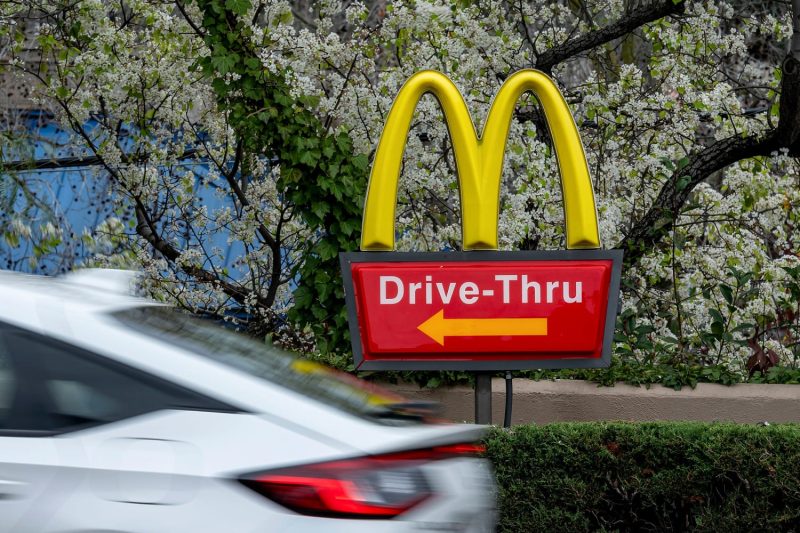
McDonald’s on Monday reported disappointing quarterly revenue, dragged down by weaker-than-expected sales at its U.S. restaurants following an E. coli outbreak just weeks into the quarter.
But shares of the company rose more than 4% in morning trading as executives predicted sales would improve in 2025.
Here’s what the company reported compared with what Wall Street was expecting, based on a survey of analysts by LSEG:
Net sales of $6.39 billion were roughly flat compared with the year-ago period. The company’s overall same-store sales growth of 0.4% outperformed Wall Street’s expectations of same-store sales declines of 1%, according to StreetAccount estimates.
But McDonald’s U.S. business reported a steeper-than-expected drop in its same-store sales. Same-store sales at the company’s domestic restaurants fell 1.4% in the quarter; Wall Street was projecting same-store sales declines of 0.6%.
McDonald’s said traffic was slightly positive, but customers spent less than usual during the quarter. Over the summer, the chain rolled out a $5 combo meal to bring back price-conscious diners and reverse sluggish sales. The strategy worked, helping McDonald’s U.S. same-store sales tick up in the third quarter.
However, analysts have warned that value meals only work if customers also add menu items that aren’t discounted to their orders. McDonald’s executives downplayed those concerns Monday, saying the average check on the $5 meal deal is more than $10.
The biggest hit to McDonald’s U.S. sales came in late October, when the Centers for Disease Control and Prevention linked a fatal E. coli outbreak to its Quarter Pounder burgers. McDonald’s switched suppliers for its slivered onions, the ingredient fingered as the likely culprit for the outbreak. In early December, the CDC declared the outbreak officially over.
However, in the days following the news of the outbreak, traffic at McDonald’s U.S. restaurants fell steeply, particularly in the states affected.
U.S. sales hit their nadir in early November, but began rising again after that. In particular, demand for the Quarter Pounder, a popular core menu item with high margins, fell quickly in the wake of the crisis.
McDonald’s expects its U.S. sales to recover by the beginning of the second quarter, executives said.
“I think right now what we’re seeing is that the E. coli impact is now just localized to the areas that had the biggest impact,” CEO Chris Kempczinski said on the company’s conference call. “So think about that as sort of the Rocky Mountain region that was really the epicenter of the issue.”
The company hopes value deals, along with key menu additions, will help to fuel the recovery this year. In 2025, the burger chain plans to bring back its popular snack wraps, which vanished from menus during pandemic lockdowns, and to introduce a new chicken strip menu item.
Outside the U.S., sales were stronger. Both of McDonald’s international divisions reported same-store sales increases, bolstering the company’s overall performance.
The company’s international developmental licensed markets segment, which includes the Middle East and Japan, reported same-store sales growth of 4.1%.
McDonald’s international operated markets division, which includes some of its biggest markets, reported same-store sales growth of 0.1%. The company said most markets reported same-store sales increases, but the United Kingdom and some other markets saw same-store sales shrink in the quarter. One bright spot was France, which saw its same-store sales turn positive during the quarter after months of weak demand.
McDonald’s reported fourth-quarter net income of $2.02 billion, or $2.80 per share, down from $2.04 billion, or $2.80 per share, a year earlier.
Excluding gains tied to the sale of its South Korean business, transaction costs for buying its Israeli franchise and other items, McDonald’s earned $2.83 per share.
Looking to 2025, the first quarter is expected to be the low point for McDonald’s same-store sales, CFO Ian Borden said, citing a weak start to the year in the U.S., among other factors. Winter storms and wildfires in California weighed on restaurant traffic across the industry in January.
For the full year, McDonald’s plans to open roughly 2,200 restaurants. About a quarter of those locations will be in the U.S. and its international operated markets. The rest will be in the company’s international developmental licensed markets, including about 1,000 new restaurants in China.
Including its investments in restaurant openings, McDonald’s plans to spend between $3 billion and $3.2 billion this year on capital expenditures.
The company is also projecting a headwind of 20 cents to 30 cents per share to its full-year earnings due to foreign currency exchange rates.
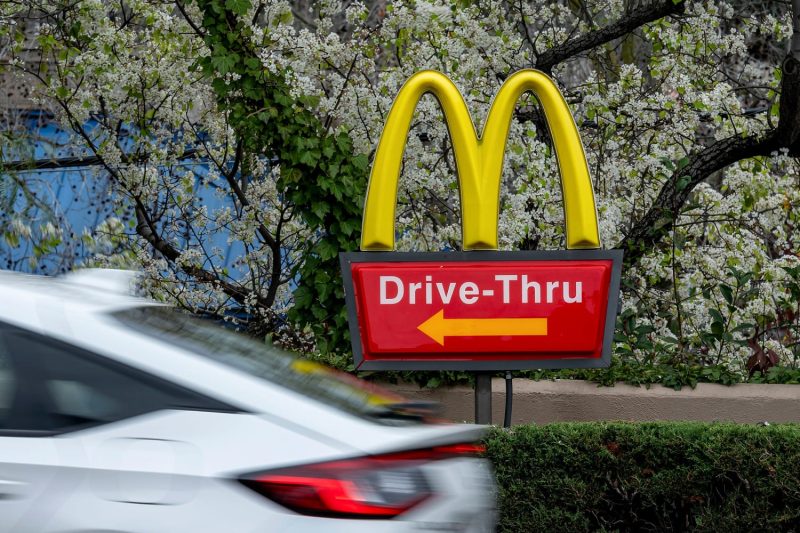
McDonald’s on Monday reported disappointing quarterly revenue, dragged down by weaker-than-expected sales at its U.S. restaurants following an E. coli outbreak just weeks into the quarter.
But shares of the company rose more than 4% in morning trading as executives predicted sales would improve in 2025.
Here’s what the company reported compared with what Wall Street was expecting, based on a survey of analysts by LSEG:
Net sales of $6.39 billion were roughly flat compared with the year-ago period. The company’s overall same-store sales growth of 0.4% outperformed Wall Street’s expectations of same-store sales declines of 1%, according to StreetAccount estimates.
But McDonald’s U.S. business reported a steeper-than-expected drop in its same-store sales. Same-store sales at the company’s domestic restaurants fell 1.4% in the quarter; Wall Street was projecting same-store sales declines of 0.6%.
McDonald’s said traffic was slightly positive, but customers spent less than usual during the quarter. Over the summer, the chain rolled out a $5 combo meal to bring back price-conscious diners and reverse sluggish sales. The strategy worked, helping McDonald’s U.S. same-store sales tick up in the third quarter.
However, analysts have warned that value meals only work if customers also add menu items that aren’t discounted to their orders. McDonald’s executives downplayed those concerns Monday, saying the average check on the $5 meal deal is more than $10.
The biggest hit to McDonald’s U.S. sales came in late October, when the Centers for Disease Control and Prevention linked a fatal E. coli outbreak to its Quarter Pounder burgers. McDonald’s switched suppliers for its slivered onions, the ingredient fingered as the likely culprit for the outbreak. In early December, the CDC declared the outbreak officially over.
However, in the days following the news of the outbreak, traffic at McDonald’s U.S. restaurants fell steeply, particularly in the states affected.
U.S. sales hit their nadir in early November, but began rising again after that. In particular, demand for the Quarter Pounder, a popular core menu item with high margins, fell quickly in the wake of the crisis.
McDonald’s expects its U.S. sales to recover by the beginning of the second quarter, executives said.
“I think right now what we’re seeing is that the E. coli impact is now just localized to the areas that had the biggest impact,” CEO Chris Kempczinski said on the company’s conference call. “So think about that as sort of the Rocky Mountain region that was really the epicenter of the issue.”
The company hopes value deals, along with key menu additions, will help to fuel the recovery this year. In 2025, the burger chain plans to bring back its popular snack wraps, which vanished from menus during pandemic lockdowns, and to introduce a new chicken strip menu item.
Outside the U.S., sales were stronger. Both of McDonald’s international divisions reported same-store sales increases, bolstering the company’s overall performance.
The company’s international developmental licensed markets segment, which includes the Middle East and Japan, reported same-store sales growth of 4.1%.
McDonald’s international operated markets division, which includes some of its biggest markets, reported same-store sales growth of 0.1%. The company said most markets reported same-store sales increases, but the United Kingdom and some other markets saw same-store sales shrink in the quarter. One bright spot was France, which saw its same-store sales turn positive during the quarter after months of weak demand.
McDonald’s reported fourth-quarter net income of $2.02 billion, or $2.80 per share, down from $2.04 billion, or $2.80 per share, a year earlier.
Excluding gains tied to the sale of its South Korean business, transaction costs for buying its Israeli franchise and other items, McDonald’s earned $2.83 per share.
Looking to 2025, the first quarter is expected to be the low point for McDonald’s same-store sales, CFO Ian Borden said, citing a weak start to the year in the U.S., among other factors. Winter storms and wildfires in California weighed on restaurant traffic across the industry in January.
For the full year, McDonald’s plans to open roughly 2,200 restaurants. About a quarter of those locations will be in the U.S. and its international operated markets. The rest will be in the company’s international developmental licensed markets, including about 1,000 new restaurants in China.
Including its investments in restaurant openings, McDonald’s plans to spend between $3 billion and $3.2 billion this year on capital expenditures.
The company is also projecting a headwind of 20 cents to 30 cents per share to its full-year earnings due to foreign currency exchange rates.

Shares of GameStop and MicroStrategy were on the rise Monday after Ryan Cohen, CEO of the video game retailer, posted a photo with Michael Saylor, co-founder and chairman of the largest corporate holder of bitcoin.
GameStop, day traders’ favorite meme stock, climbed more than 7%, while MicroStrategy, which recently rebranded as “Strategy,” saw shares rising as much as 4%. Cohen uploaded the photo over the weekend on X, sparking speculation that GameStop is plotting another strategy around crypto. MicroStrategy shares last traded up 1%.
The video game company had expanded into digital services in recent years by offering crypto wallets that let users manage their crypto and nonfungible tokens. However, the firm shut the service down in 2023, citing “regulatory uncertainty.”
Cohen, co-founder of Chewy, bought shares in GameStop in 2020 and joined the board in 2021 as GameStop became one of the key stocks in the WallStreetBets meme trading mania.
His e-commerce experience fueled hopes that he could help modernize the brick-and-mortar retailer, but the company still struggles to adapt to changing spending habits by gamers. Trading in the stock remains highly volatile and speculative as meme stock personality “Roaring Kitty” continues to spur buying from retail investors.
Saylor’s Strategy also has a fan base of retail investors as the firm touted its aggressive bitcoin-buying strategy. In the past year, the firm has raised billions of dollars through the sale of stock or convertible bonds for the sole purpose of purchasing more bitcoin.
Last week, Strategy said it’s almost halfway to its ambitious capital-raising goal as it went on a buying spree throughout the postelection rally. As of Monday, Strategy holds roughly $47 billion worth of bitcoins on its balance sheet, about 2.5% of the total supply.

The trading week started with investors worried about tariffs, but the 30-day delay of tariffs on imports from Canada and Mexico shook off those worries. The three broad stock market indexes — S&P 500 ($SPX), Nasdaq Composite ($COMPQ), and Dow Jones Industrial Average ($INDU) — closed higher. Then came the retaliation on US tariffs from China, but that didn’t do much damage to the market.
Let’s face it; the stock market is headline-driven at the moment. Based on the news, investors may favor healthcare stocks one day and tech stocks the next. For individual investors, playing the sector musical chair game makes for a difficult investment environment. So, instead of getting caught up in catching the right sector at the right time, it’s best to focus on the big picture and look at the longer-term trends and patterns. One way to do this is to examine the performance of different sectors, industry groups, and indices through the Bullish Percent Index (BPI).
StockCharts Tip: If you haven’t done so, download the Essentials ChartPack (Charts & Tools tab > ChartPacks). The Market & Index Bullish Percent Indexes list has seven charts in the ChartList (see below).
FIGURE 1. DOWNLOADING CHARTPACKS. From the Charts & Tools tab, select ChartPacks to download the Essentials ChartPack.Image source: StockCharts.com. For educational purposes.
You could add more charts to the list. For example, I use a BPI ChartList each day to determine which sectors are bullish, overbought, or oversold. The image below displays some of the charts in my BPI ChartList.
FIGURE 2. VIEWING THE BULLISH PERCENT INDEX (BPI) CHARTLIST. The Summary view helps to see which sectors are bullish, bearish, overbought, or oversold.Image source: StockCharts.com. For educational purposes.
Viewing the ChartList in the Summary view helps to identify if the BPI is bullish, bearish, overbought, or oversold. You can also identify which sectors had the biggest changes for the day.
In the above image, the S&P Financial Sector BPI was the only one above 70, and Consumer Staples Sector BPI or $BPSTAP (not visible in the image; you’ll have to scroll to the next page) was the only one below 30.
On Wednesday, the Predefined Alerts panel flashed that the Consumer Staples Sector BPI crossed above 30. This was a bull alert trigger warranting a closer look.
The chart below displays $BPSTAP with the Consumer Staples Select Sector SPDR ETF (XLP).
FIGURE 3. CONSUMER STAPLES BPI VS. CONSUMER STAPLES SELECT SPDR ETF (XLP). The BPI for the Consumer Staples Sector has crossed above 30, which is a bull alert trigger. The XLP chart still has to confirm a bullish move.Chart source: StockCharts.com. For educational purposes.
Although the $BPSTAP has crossed above 30, the XLP chart doesn’t display a bullish trend. Given that inflation is a big concern among US consumers, it’s worth monitoring the Consumer Staples sector for a chance to buy some stocks.
We posted an article on three stocks in the Consumer Staples sector, focused on Walmart, Inc. (WMT), Costco Wholesale Corp. (COST), and Sprouts Farmers Market (SFM). These stocks are still looking strong, but come with a high price tag. So, instead of purchasing the stock outright, I decided to explore options strategies for these stocks.
After analyzing all three stocks using the Options tool (see image below), I considered a call vertical spread on COST and WMT. SFM wasn’t under consideration since it had a low-scoring strategy.
WMT was the lower-risk play, so I placed the April 17 100/115 call vertical, a strategy displayed in the OptionsPlay Explorer tool, with my broker (see image below). I got filled at a price slightly higher than $508 due to price fluctuations and broker fees.
FIGURE 4. OPTIONSPLAY EXPLORER DISPLAYS THREE OPTIMAL TRADES FOR WMT. The April 17 100/115 call vertical was the most optimal trade with a good risk/reward tradeoff. Image source: OptionsPlay Add-on at StockCharts.com. For educational purposes.
There are 71 days till expiry. If WMT closes above $105.08 the trade will be profitable. The target price is $113.82.
There’s a 38.89% probability of the stock closing above $105.08 by expiration, all else equal. I’ll monitor the position and, if the price target is reached, I will close my position. Another point to keep in mind is that WMT reports earnings on February 20 before the market opens. Volatility will likely increase around that time and could significantly move the stock price in either direction.
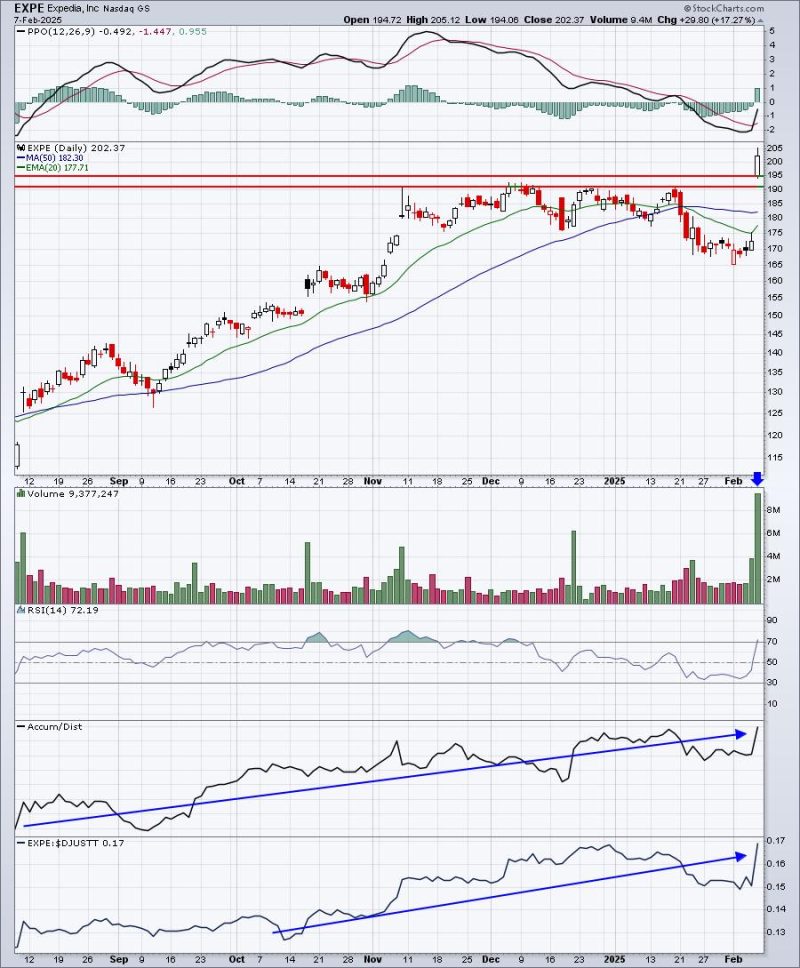
Sometimes an industry group looks good technically, sometimes fundamentally, and then other times seasonally. But what happens when they all line up simultaneously? Well, we’re about to find out with the travel & tourism group ($DJUSTT). On Friday, Expedia (EXPE, +17.27%) soared after reporting blowout quarterly results after the bell on Thursday. Revenues easily surpassed consensus estimates, $3.18 billion vs. $3.08 billion and EPS did the same, $2.39 vs. $2.07. Here’s how EXPE looked on its chart after Friday’s surge:
EXPE now has excellent support in the 191-195 zone, in my opinion. 191 was the price resistance prior to Friday’s gap higher and 195 (actually 194.72) was the gap opening on Friday on over 8 million shares, its 3rd largest volume day of the past year. Booking Holdings (BKNG) is set up to potentially do the same – report blowout numbers and soar to all-time highs – when it reports its quarterly results on Thursday, February 20, 2025.
The DJUSTT had been consolidating after an earlier run higher in 2024. This now looks like an uptrend, followed by a potential cup pattern:
In the bottom panel, watch the relative strength line for the DJUSTT vs. the benchmark S&P 500. A breakout here to a multi-month high would bode well for the group.
I certainly don’t want to leave out seasonality. Travel & tourism THRIVES beginning in February and running through . Check this out:
The next 3 months – February through April – averages gaining 10.6% per year for the past two decades! These 3 months also rank the highest for the DJUSTT, in terms of the odds of these months ending higher than they began. February and March have both moved higher roughly 75% of the years since 2005.
This is the TRIFECTA – fundamentals strengthening, technicals lining up, and seasonal tailwinds.
Well, that’s another story. Obviously, the DJUSTT would likely do better in a strong overall market environment and we just received another clue on the S&P 500 via the “January Effect”. There’s an old adage on Wall Street that says, “So goes January, so goes the year.” There’s a lot of truth to this statement and it generally depends on how the S&P 500’s January performance ranks vs. all the Januarys past. Exactly where did January 2025 rank and what does it tell us about the balance of 2025?
That’s the subject of our “January Effect” members-only webinar on Monday, February 10th. If you’d like to be part of this webinar, simply CLICK HERE to learn more about the event and take advantage of our FREE 30-day trial!
Happy trading!
Tom
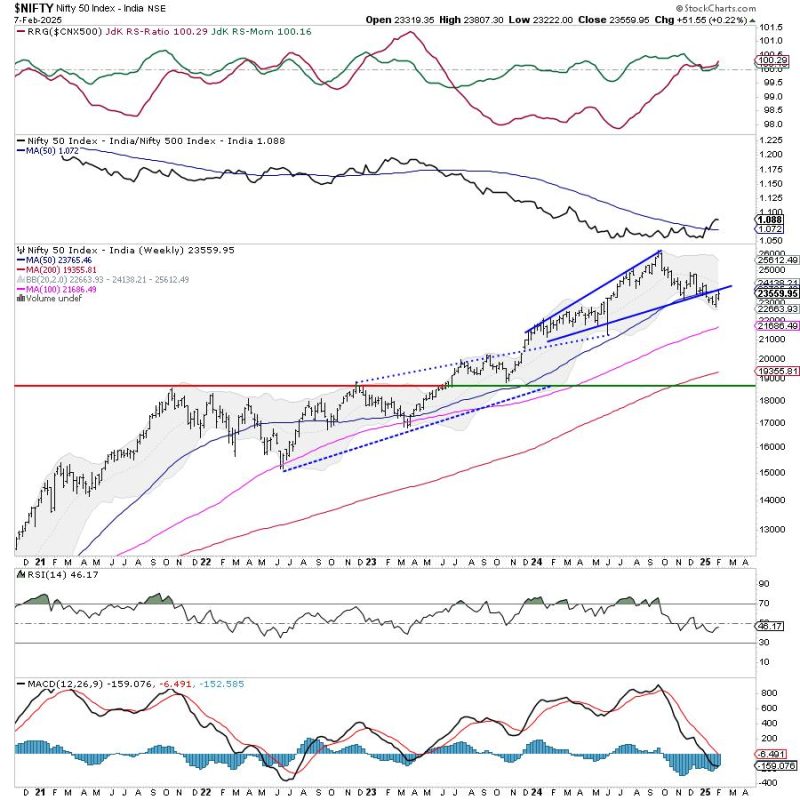
In what can be called an indecisive week for the markets, the Nifty oscillated back and forth within a given range and ended the week on a flat note. Over the past five sessions, the Nifty largely remained within a defined range. While it continued resisting the crucial levels, it also failed to develop any definite directional bias throughout the week. The Nifty stayed and moved in the 585-point range. The volatility significantly declined. The India VIX came off by 15.77% to 13.69 on a weekly note. While trading below crucial levels, the headline index closed flat with a negligible weekly gain of 51.55 points (+0.22%).
A few important technical points must be noted as we approach the markets over the coming weeks. Both the 50-Day and 50-Week MA are in very close proximity to each other at 23754 and 23767, respectively. The Nifty has resisted to this point, and so long as it stays below this level, it will remain in the secondary corrective trend. For this secondary trend to reverse, the Nifty will have to move past the 23750-24000 zone, one of the critical market resistance areas. Until we trade below this zone, the best technical rebounds will face resistance here, and the markets will remain vulnerable to profit-taking bouts from higher levels. On the lower side, keeping the head above 23500 will be crucial; any breach of this level will make the markets weaker again.
The weekly RSI stands at 46.20. It remains neutral and does not show any divergence against the price. The weekly MACD is bearish and stays below its signal line. A Spinning Top occurred on the candles, reflecting the market participants’ indecisiveness.
The pattern analysis weekly charts show that after violating the 50-week MA, the Nifty suffered a corrective decline while forming the immediate swing low of 22800. The subsequent rebound has found resistance again at the 50-week MA at 23767, and the Nifty has retraced once again from that level. The zone of 23700-24000 is now the most immediate and major resistance area for the Nifty over the immediate short term.
Unless the Nifty crosses above the 23700-24000 zone, it will remain in a secondary downtrend. On the lower side, keeping head above the 23500 level will be crucial; any violation of this level will take Nifty towards the 23000 mark. The markets may continue to reflect risk-off sentiment overall. Given the current technical setup, remaining highly selective while making fresh purchases would be prudent. All technical rebounds should be used more to protect gains at higher levels. At the same time, staying invested in stocks with strong or at least improving relative strength while keeping overall leveraged exposures at modest levels is important. A cautious and selective approach is advised for the coming week.
In our look at Relative Rotation Graphs®, we compared various sectors against CNX500 (NIFTY 500 Index), which represents over 95% of the free float market cap of all the stocks listed.
Relative Rotation Graphs (RRG) show defensive and risk-off setups building up in the markets. Nifty Bank, Midcap 100, and Realty Indices are inside the leading quadrant. But all these pockets show a sharp loss of relative momentum against the broader markets.
The Nifty Financial Services Index has slipped inside the weakening quadrant. The Nifty Services Sector and IT indices are inside the weakening quadrant. The Pharma Index is also inside this quadrant but is seen as attempting to improve its relative momentum.
The Nifty Media, Energy, and PSE indices are inside the lagging quadrant.
The Nifty FMCG, Consumption, and Commodities groups have rolled inside the improving quadrant, indicating a likely onset of the phase of relative outperformance. The Auto, Infrastructure, Metal, and PSU Bank indices are inside the improving quadrant. Among these groups, the PSU Bank Index is seen rapidly giving up on its relative momentum.
Important Note: RRG charts show the relative strength and momentum of a group of stocks. In the above Chart, they show relative performance against NIFTY500 Index (Broader Markets) and should not be used directly as buy or sell signals.
Milan Vaishnav, CMT, MSTA
Consulting Technical Analyst
In this video, Mary Ellen reviews the market’s flat momentum as uncertainty reemerges after weak AMZN, TSLA and GOOGL reports – PLUS more tariff talk from Trump. She also highlights the move into defensive sectors as growth stocks continue to struggle. Lastly, she shares the top stocks that are keeping the S&P 500 in an uptrend.
This video originally premiered February 7, 2025. You can watch it on our dedicated page for Mary Ellen’s videos.
New videos from Mary Ellen premiere weekly on Fridays. You can view all previously recorded episodes at this link.
If you’re looking for stocks to invest in, be sure to check out the MEM Edge Report! This report gives you detailed information on the top sectors, industries and stocks so you can make informed investment decisions.